Dolphin Sonar gives you complete control over your browser using only your voice.
Dolphin Browser is arguably one of the best third-party browsers for iOS, and the iPhone version just became even better with its latest update. Version 4.0 brings a stack of new features including Dolphin Sonar voice controls, a URL keyboard, and a night mode — and it’s available to download now.
Social network Path came under great scrutiny after it was discovered that the app would upload a user’s entire address book to Path’s servers. The worst part, for iOS users at least, was Path never let them know. After a public apology, Path worked diligently to remedy the issue and came up with a few enhancements to the way they handle user privacy. Today, Path has rolled out an update to both its Android and iOS apps reflecting the changes and assuring users that they take their privacy seriously (or at least now they do).
Record, transcribe, send text on your older iPhone
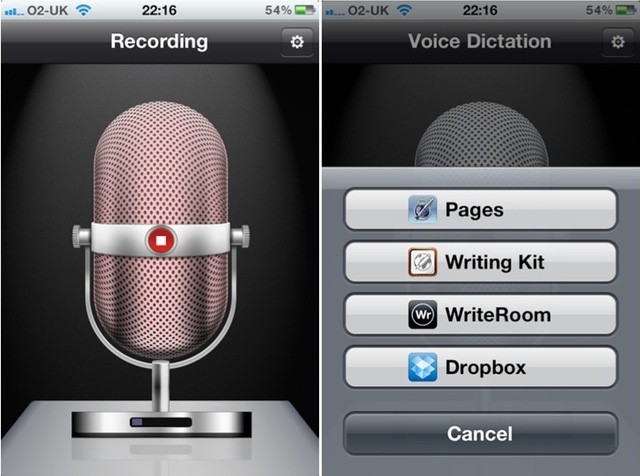
Voice Dication, or Voice Dictation – Voice To SMS, Email, Facebook, Twitter And Other Apps to give it its full name, is a voice control app from Europe, designed to offer something vaguely Siri-like to those of us still stuck in the Dark Ages on our pre-4S iPhones.
Does it work? Well yes, actually it does. Better than expected.
RIM expands BlackBerry Mobile Fusion to support iOS and Android management
RIM has launched iOS and Android support in its BlackBerry Mobile Fusion mobile device management (MDM) software. The new feature known as Universal Device Service follows February’s initial launch of BlackBerry Mobile Fusion. The initial launch primarily provided the ability to manage RIM’s PlayBook tablet. The launch of the iOS and Android components of the software have been expected for quite some time.
The release is likely to be welcome news to companies and IT departments that are established customers of RIM products. Beyond those customers, however, BlackBerry Mobile Fusion simply joins a long list of existing MDM services that support iOS, Android, Windows Phone, and Even RIM’s own BlackBerry OS.
The Fling controller from TenOne Design (soon to be reviewed) is a great way to add a physical to your iPhone or iPad, just by suction-cupping it onto the screen. This means that it works with any game on your iOS device that uses an on-screen “joystick.”
The downside is that it moves at the worst moments: I have wiped out in more than one GTA car chase this way. But designers at the Keio University in Japan have come up with another idea. A joystick which uses the iPhone’s camera as a controller.
No, it's too small to read here. Don't even try it
There are more iOS text editors in the App Store than there are stupid giant-screen iPhone rumors “sourced” by Digitimes. And this makes it impossible to choose. Does Elements support iCloud? Does Readdle Docs play nice with TextExpander? And have you ever even heard of FastEver XL? The answer to all these questions, plus many you didn’t even think to ask, are in Brett Terpstra’s exhaustive, crowd-sourced iOS Text Editor roundup.
Firefighters in China’s Yunnan Province have rescued a two-year old toddler from a 40-foot well with the help of Apple’s iPhone. After the child kept slipping out of a rescue harness that was designed for adults, an iPhone was lowered into the well so that the rescue team could use its camera to see the boy’s position.
A new Israeli start-up on the scene named ZooZ has founded a new SDK, which allows developers to implement an in-app payment system into their apps easier. To get the system implemented, all developers have to do is add three lines of code into either an Android or iOS app, which will then get things rolling. From there, customers who would like to purchase something from within the app can use Paypal or a credit card with ZooZ’s system. Check it out:
Barefoot Books World Atlas ($8) is a kind of digital globe for children, giving them easy access to a simplified cartoon overview of the whole world.
From the orbital view (for want of a better word), you see the globe peppered with hundreds of colorful icons. Spin the globe and zoom in. The little icons grow and become tappable controls. Each one reveals a snippet of information in text and audio form (read aloud by the UK’s favorite TV geographer (yes, we have those), Nick Crane). There’s also a photo to look at for each fact, which is often much more informative than the icon was to start with.
Using the iPhone's headphone jack, you can control your camera any which way you like
After years of tweaking and improvement, ioShutter is finally here. ioShutter is a simple cable that connects your iPhone to your camera and allows you to control it using an app. Remote shooting, time-lapse sequences and even photos triggered by sound can all be programmed in easily using the free companion app. And best of all, no fancy dock connectors are required: ioShutter connects through the headphone jack.
Gameloft's Modern Combat series of first-person shooters would be so much better with a physical controller.
As a gamer, I’d love nothing more than to see a proper physical controller for my iOS devices. Sure, the touchscreen works great with titles like Angry Birds or Words With Friends, and accessories like the iCade work well with retro games. But for first-person shooters, soccer sims, 3D platformers and the like, nothing beats a physical controller with real analog sticks and real buttons.
Google’s Android operating system already supports external game controllers, and that’s one of the few things it has over iOS. But maybe not for long. According to one source, Apple is working on a physical controller of its own that will make iOS gaming even more incredible.
SwipeBack is a great way to navigate back through iOS menus with a swipe.
SwipeBack is a new tweak for jailbroken iPhones that allows you to elegantly navigate back through your menus by swiping your finger across your screen, rather than tapping on the buttons at the top of the display. It’s currently still in beta, but it works well and you can get your hands on it now.
Historically, developers have earned 70% of the revenue from application downloads from the App Store and 60% from iAd revenue, but today comes good news for those of you who use the iAd platform in your apps. Apple has revealed on its Developer Center that developers will now be earning an extra 10% from iAd revenue, boosting it to 70% in total. Is this Apple’s push to get the advertising service into more apps?
Note: Title has been changed to reflect “in-app” revenue
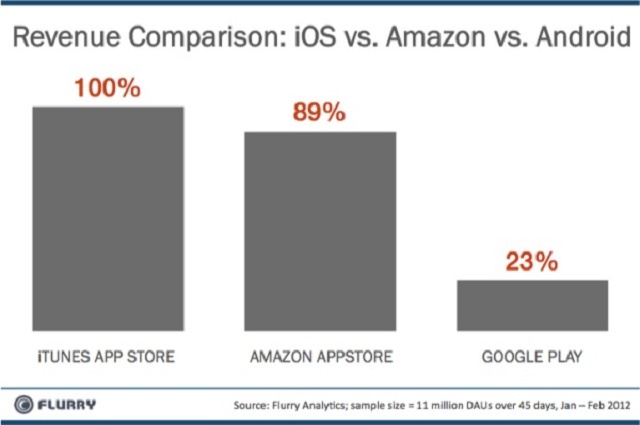
You may have seen this report around the web about the Amazon Appstore generating more in-app revenue than the Google Play Store. While that in itself it impressive, everyone seems to be missing the most important detail of the report: Android is generating more in-app revenue than iOS. At least that’s what this report is claiming.
The instruments browser offers a range of keyboards, guitars, basses, amps and effects, and a sampler.
The recently-updated version of GarageBand — Apple’s popular music-making app for the iPad — finally turns it into a serious tool for bands rather than something limited to solo artists and their session collaborators. With a shared connection, up to four band members can play or jam to a piece of music, be it a pop song or a classical overture. For the first time, it brings live performance to the iPad app.
BYOD may be the poster child for the consumerization of IT (CoIT) movement, but employee-owned mobile devices are just one of the consumer technologies that are steadily making their way into the workplace. Consumer cloud services are another big headache for IT.
Consumer clouds represent a way for data to easily leave office and the office network. Files can be placed in a consumer cloud very easily and often without IT even knowing about it. Despite that big security concern, cloud services like Box and Dropbox are popular with workers because they’re an easy way to ensure access to files and documents while out of the office and/or while working on a mobile device.
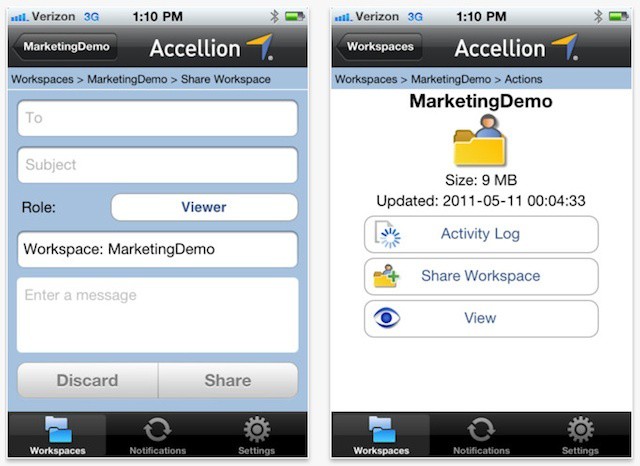
While blocking specific cloud services is a possibility, it’s little more than a stop-gap measure. Truly solving the problem means addressing the underlying need – users needing mobile access to data – in a secure way, which enterprise file management company Accellion aims to solve with a new Secure Mobile File Sharing service and sync capabilty dubbed kitedrive.
The immensely popular MMO Pocket Legends is turning two and Spacetime Studios is throwing a celebration to honor all of its milestones and devoted fan base. The now cross-platform global hit, Pocket Legends, was originally launched on iOS April 3rd, 2010. Since then, Pocket Legends has been played in every country on the planet (with the exceptions of Cuba and North Korea) by over five million people. That’s an impressive feat for a mobile MMO! Spacetime Studios thinks so too, that’s why players will now have access to all Pocket Legends premium content areas for free!
Quickoffice's new Connect service offers great potential but at a price
Earlier this Box launched its new OneCloud feature, the goal of which is to integrate a range of iOS business and productivity apps around Box’s cloud storage. The biggest advantage to OneCloud is that it neatly sidesteps the lack of file management in iOS, essentially functioning almost like cloud-centric iOS version of the Finder.
Box isn’t the only company looking to get around the iOS file limitations while also connecting users to the cloud. Quickoffice this week announced its new Connect solution, a dedicated app and cloud service combination that aims to make it easy for users to access, edit, share, and sync files and documents across all their devices as well as across a range of third-party cloud services.
AppRedeem is hoping iOS devs will follow Groupon's lead and adopt its UDID alternative.
Just six months after announcing that developers must stop accessing a device’s unique device identifier (UDID) within their iOS apps, Apple put its rule into practice last week amid increasing privacy concerns surrounding mobile apps. Any app submitted for App Store approval will soon be rejected if its attempts to access a UDID, and developers need an alternative.
That alternative could come from AppRedeem, a mobile advertising platform for app discovery, branding and monetization, which has developed a system called Organizational Specific Device Identifier, or “ODID,” already being used by Groupon.
Don't expect to see Cydia on your new iPad anytime soon.
Just hours after its release on March 16, Apple’s new iPad was jailbroken by the iPhone Dev-Team. Their announcement gave us hope that an exploit for A5 and A5X devices running iOS 5.1 would be available within weeks, but it now seems like we’ll be waiting a whole lot longer than that.
RIM's new CEO finally acknowledges the company's dire position
After months of denying and downplaying its problems, RIM seems to finally be waking up from its delusional fantasy world and accepting that it’s in extremely dire straights. That was the big take away from the company’s quarterly financial call Thursday evening.
The call was the first headed by the company’s new CEO Thorsten Heins, who took over earlier this year after the resignation of co-CEOS Jim Balsillie and Mike Lazaridis. Heins made it clear that he understands the challenges facing RIM (as well as the delusional thinking that created many of them) and that he cannot guarantee the company’s success as it struggles realign itself to the current mobile market.
IBM relies on user education, device management to leverage BYOD
IBM, once known as on of the most straight-laced companies in the world, has jumped on the BYOD bandwagon with a level of enthusiasm rarely seen in such large and established enterprises. The company has big plans for BYOD – rolling out a program out that covers all 440,000 employees worldwide.
That’s a big challenge and one that Big Blue has yet achieve. However, the company currently has mobility solutions deployed to about a quarter of its workforce (120,000 users) two thirds of whom (80,000) are supplying their own devices and service plans. The company, which had been a predominantly BlackBerry shop, began to shift gears as iPhones and other devices began showing up in its offices.
While not a model for every company, IBM’s BYOD policies can serve as a great starting point.
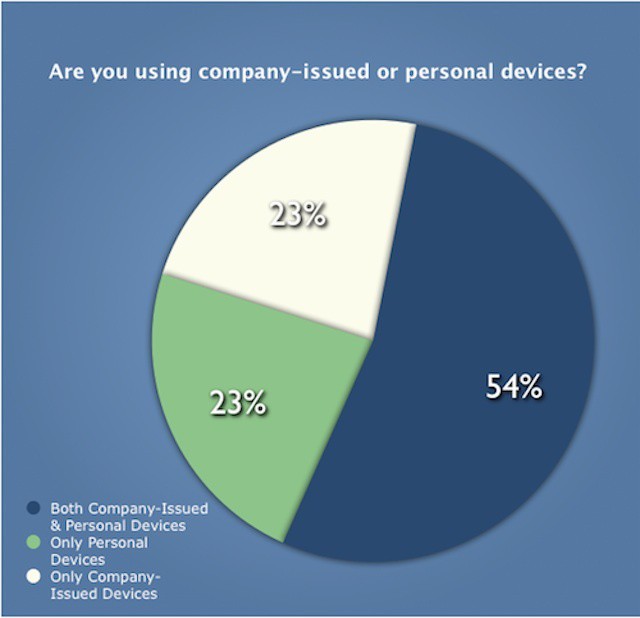
77% of people use personal tech on the job with or without company devices
Earlier today, we reported on the variability in how companies can define BYOD programs. For some companies BYOD can mean access to just email while in others it can include a range of customer internal apps along with company-purchased selections for the App Store. The exact mix of allowed or supported functionality reflects the IT and management culture of an organization but it can be guided by what users feel they need most.
Email may be the lowest common denominator when it comes to BYOD because it is the most common use of mobile devices in the workplace. That statistic stands out in a new report on how businesses and employees are using mobile technology and how businesses are addressing BYOD as a trend.