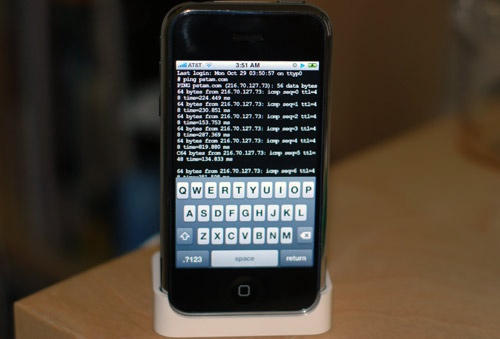
Update: As reader Mike kindly points out in the comments, apps running in root was fixed in the 1.1.3 update.According to Cre.ations.net: – All applications now run as the user ‘mobile’ instead of as root. – Preferences are now stored in /var/mobile rather than in /var/root. Update 2: As Wired.com reporter Kim Zetter points out, this hasn’t been confirmed by anyone except the Cre.ations.net blogger. All other mentions cite Cre.ations.net as the source.
If today’s iPhone’s firmware update is in preparation for an iPhone SDK, the big question is whether Apple fixed the iPhone’s flawed security model. Do apps still run in root?
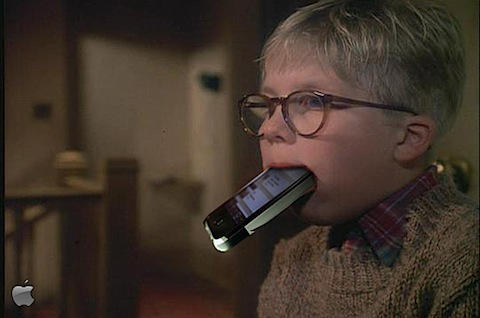
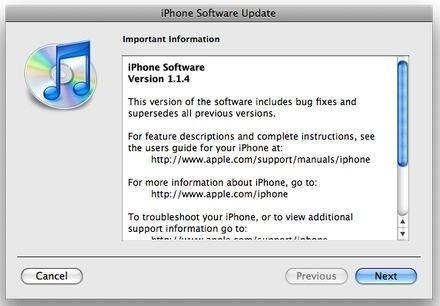
Apple on Tuesday released a 1.1.4 firmware update for the iPhone and iPod touch.
Available through iTunes, the update is a beefy 165-MByte download, but incredibly, adds no significant new features.
According to iLounge, which examined the update closely and quizzed Apple about it, it’s nothing but bug fixes.
The update is probably laying the groundwork for the iPhone SDK, which Apple promised to release this month.
The 1.1.4 update presents no problem to jailbroken iPhones, TUAW reports — which will be a moot point if sanctioned applications will be released shortly. Who wants to hack their iPhone to load applications if there’s a nice SDK a way to load them through iTunes?
Image via Paul Stamatiou
It’s an open secret that there are legions of iPhone owners who operate their phones outside of Apple’s officially sanctioned networks AT&T, O2, Orange, and T-Mobile Germany, either because they live outside of the countries where the iPhone is on sale or because they’re aware that AT&T has terrible coverage.
What is less well-known is just how big the problem has gotten. BusinessWeek reported last week that 800,000 to 1 million iPhones have gone AWOL after legitimate purchase. And now this weekend, analyst In-Stat claims that 400,000 of those iPhone are all in operation on China Mobile, the largest carrier in Mainland China.
This makes a few things clear:
Apple should get a distribution deal in China as fast as they can. They’re just leaving money on the table right now.
Apple would be making more money if they hadn’t gone with an exclusive network for each market. If the iPhone ran GSM and CDMA and was available far and wide, they would be making more money and they wouldn’t need to concern themselves with unlocking. By getting into bed with AT&T and making a part of its revenue dependent on “legitimate use,” Apple has taken an anti-consumer stance that will hurt it in the long run. Unlocked iPhones are only a problem because they depend on an outdated business model. Apple should be embarrassed for taking part in it.
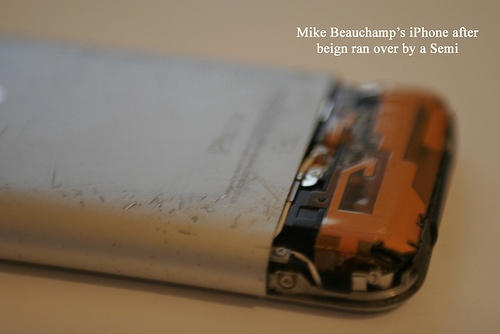
Mike Beauchamp’s iPhone has been through hell and back – and it’s still working. He tells the story in graphic detail at Flickr.
As the last pair of headlights approached, the semi got over to the far outside lane because he saw me standing on the side of the road. I knew this was trouble. As I watched helplessly from the shoulder, the semi plowed my phone at full speed, throwing it to the ditch on the other side of the highway. At this point, I figured I’d retrieve it just for the purpose of seeing the crushed iPhone in disarray, mangled and crunched lifeless in the grass.
Much to my surprise, as I approached, I heard the familiar sound of my ringtone — the iPhone was alive and ringing! As I picked it up and cradled it gently in my hands, I saw the screen displaying my caller ID — the screen still worked! I slid my finger gently over the answer slide and paused as I held the tattered and torn device to my ear — my heart must have skipped a beat when I heard my mom’s voice at the other end of the phone — the phone still worked!
Word has just come in from UK iPhone carrier O2 that the company has missed its goal of 200,000 iPhones sold since Nov. 9. Apple managed to move 190,000 iPhones in the UK, and rumors and early reports suggest the iPhone has been slow to gain traction in Europe.
Which really isn’t too surprising. As much as some people in the U.S. have complained about a lack of tactile feedback on the iPhone’s keyboard, we’re novices in texting compared to Europe and Asia. People are so fast at T9 texting over there that many hardcore users are faster with a standard keypad than they are with a QWERTY thumbpad, let alone a QWERTY touchscreen.
Bruce Nussbaum over at BusinessWeek speculates that the iPhone’s weak texting capability might be to blame. Though iPhone software 1.1.3 now supports multi-user texts, it still doesn’t allow SMS forwarding, both of which are key features in the UK and especially in India. A co-worker of mine noted on Friday that texting is so prevalent in India compared to e-mail that people in India circulate lame jokes to their friends via SMS instead of e-mail. The lack of a physical keyboard will never fly over there.
The iPhone is far from in trouble in the U.S. – it could scarcely be doing better, but I do wonder about its long-term future overseas. Mobile phones play a very different role in Europe and Asia than they do here, and the iPhone will need to work harder to make an impact.
Colleague Fred Vogelstein has a great article on the creation of the iPhone in the new issue of Wired. It’s largely written based on anonymous sources (not a shock when dealing with Apple), but the narrative is quite compelling. I wish he got a bit more into just how much the iPhone has shaken up the wireless industry, but the article’s well-worth your time:
It was a late morning in the fall of 2006. Almost a year earlier, Steve Jobs had tasked about 200 of Apple’s top engineers with creating the iPhone. Yet here, in Apple’s boardroom, it was clear that the prototype was still a disaster. It wasn’t just buggy, it flat-out didn’t work. The phone dropped calls constantly, the battery stopped charging before it was full, data and applications routinely became corrupted and unusable. The list of problems seemed endless. At the end of the demo, Jobs fixed the dozen or so people in the room with a level stare and said, “We don’t have a product yet.”
I love the marriage proposals of Mac geeks. The above video is the latest and greatest, adopting the form of an iPhone demo commercial to find new, sweet ways to propose in virtually every mode of the wunderphone’s operation. I still have a soft spot for James and Uschi. Makes me tear up every time. Video after the jump.
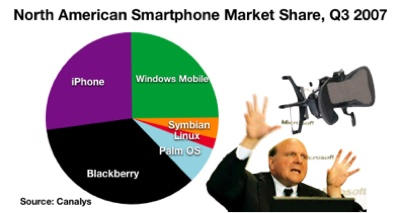
Apple’s entry into the mobile phone market has been a pretty spectacular success in its first six months on the market, according to research house Canalys. As Roughly Drafted notes, in North America, the iPhone is the No. 2 smartphone platform, not just model. It trails only the full BlackBerry market at this point, but is ahead of all combined Windows Mobile devices. This confirms an earlier NPD report that Apple was commanding about 27 percent of the smartphone market. In honor of this moment, let’s look back at some memorable quotes of the last year:
“There’s no chance that the iPhone is going to get any significant market share. No chance.”
— Steve Ballmer, Microsoft CEO
“We’ve learned and struggled for a few years here figuring out how to make a decent phone. PC guys are not going to just figure this out. They’re not going to just walk in.” — Ed Colligan, Palm CEO
“They would have been stepping in between us and our customers to the point where we would have almost had to take a back seat “¦ on hardware and service support.” — Jim Gerace, Verizon Wireless VP “What Apple risks here is its reputation as a hot company that can do no wrong. If it’s smart it will call the iPhone a ‘reference design’ and pass it to some suckers to build with someone else’s marketing budget. Then it can wash its hands of any marketplace failures.” — John Dvorak, International Tool
Ah, memories.
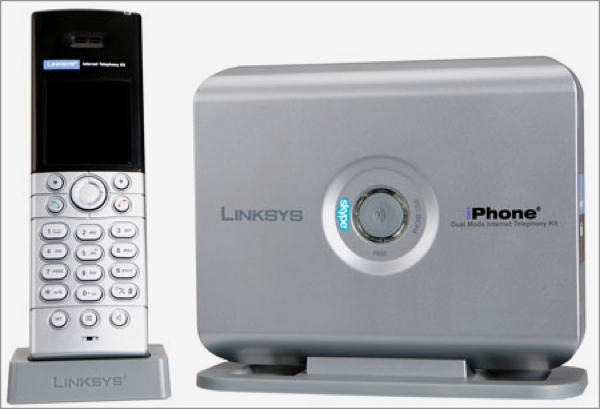
Remember a year ago, when the iPhone was announced? No, not Apple’s iPhone, the VoIP product line from Cisco’s Linksys product line! Though Cisco enjoyed a lot of press after Steve Jobs gave Apple’s revolutionary multi-touch wonderphone the same name, but then the other iPhone sort of vanished. What’s happened since?
Not much, actually. As our colleague Rob Beschizza reports for Wired News, the Linksys iPhone is selling OK, and the company plans to roll out new models under the name. But the name iPhone is Apple’s. No one, not even the most contrarian anti-Apple antagonists, thinks of seamless VoIP calls when they hear the name.
But a year on, Apple has its iPhone and Cisco has its iPhone, and no one confuses one with the other. And everybody’s happy with that, as Cisco spokesperson Karen Sohl says:
Relations with Apple, Sohl said, are good. “There’s no bad blood,” she said. “We enjoy working with Apple.”
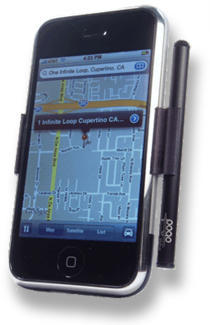
In the rush to create high-markup accessories for the iPhone, one company is hawking the Pogo Stylus: a pointing device for the Apple iPhone and iPod touch — two products expressly designed to be used without a stylus.
Is there really a market for this? I imagine the pudgy fingered might take a look, as might people who have become accustomed to poking around their smartphone with a little pen. But the whole point of Apple’s multitouch is doing away with pointing devices. But the market for iPod accessories is worth more than $1 billion annually, so companies are taking a throw-it-out-and-fingers-crossed approach. Available now from the company’s website for $25.
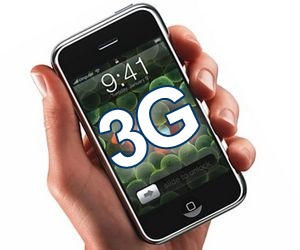
The entire world went crazy in the last 24 hours, as investors and rumor-mongers alike realized that maybe, just maybe, Apple might possibly sort of, update the iPhone with new features at some point in the future. All of the hullabaloo was set off when AT&T CEO Randall Stephenson, repeatedly pressed for information about higher-speed iPhones, said “You’ll have it next year!”
And just like that, the stock jumped up. It’s so funny. I’m going to go further, and announce that at some point in the future, Apple will release an iPhone with more storage, GPS, better typing, more applications, games and faster WiFi. Some of those features will be delivered in 2008. Does the stock go up now?
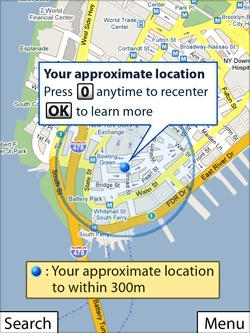
One of the enduring complaints about the first-generation iPhone (other than the price, slow EDGE data, AT&T exclusivity, limited storage, battery life, no third-party apps, no landscape keyboard outside of Safari…) is the lack of GPS support in its version of Google Maps. While several high-end smart phones now double as navigation tools, the iPhone requires you to enter your starting location for driving directions.
But that fault might soon disappear. Yesterday, Google rolled out Mobile Google Maps 2.0, which features My Location, a service that uses the positions of nearby cell phone towers to guess where you’re located. It’s not available for iPhone yet, just BlackBerry, Windows Mobile and S60 Nokias (if Apple allowed third-party apps, you’d already have it…), but it seems like an iPhone GMaps update is inevitable. I tried to make it work on my circa-2004 BlackBerry, and it doesn’t work. I now have a phone-crashing application, and that’s it.
Anyone have it working? How accurate is it in your neighborhood?
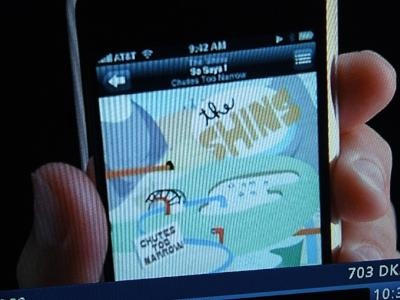
Licensing songs for commercials is a major stream of revenue for musicians these days. Moby likely wouldn’t be a household name if it weren’t for his gleeful whoring of his 1999 album Play. Inevitably, however, rampant licensing can get a little out of hand. For example, right now, The Shins are basically endorsing both the iPhone and Zune. The band’s song “Sleeping Lesson” accompanies the above the Zune ad (message: using Zune is exactly like doing acid!), while the cover of the album it comes from, Chutes Too Narrow, appears in an iPhone commercial.
Of course, this isn’t the first time a rock band has two-timed the iPhone. John Mayer, who played at MacWorld during the lunch of the device went on to endorse the BlackBerry Curve in advance. I guess a paycheck is just a paycheck, some times.
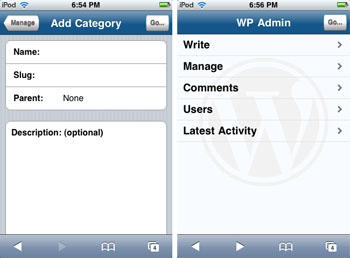
Though I still don’t have an iPhone (waiting on 3G), I’m drooling for one even more after seeing a demo of wPhone, a fantastic WordPress plug-in that allows really intuitive, full-featured blogging on the iPhone (and even some crappier ones, like my old school Blackberry). Essentially, instead of trying to render the full-bandwidth version of WP, this server-side plug-in changes the interface to optimize for iPhone or other mobile, and then uses GZip compression to enable speedy connections over EDGE and GPRS.
If all of that is gibberish, it basically means that blogging from your phone has rarely been so easy. It looks NICE.
Despite videos that claim fast iPhone typing is easy, a recent study by a usability group concludes that iPhone users make lots of typos when writing on the device. According to User Centric, iPhone text messages average 5.1 errors, or more than twice the average of mistakes made by people using full keyboard or keypad phones.
Every bit as fast, but slightly more error-prone. It’s the iPhone way.
Though anecdotal evidence suggests that the iPhone’s launch in Europe has met with less-than sizzling reception, the picture is actually nowhere near so clear.
Colleagues at Wired, for example, cite self-reports from O2 and T-Mobile of Germany that claim that the iPhone launch exceeded their expectations dramatically with sales in the “tens of thousands.” On the other hand, BusinessWeek notes with distress that it’s actually impossible to get a business contract for the iPhone in the UK at the moment — it’s only available on consumer service plans.
Jake, a Cult of Mac reader from the UK, however, seems to sum the general vibe up nicely (he practically duplicates the exact frustrated phrases my friends in the UK have):
I live in the UK and I agree that there was several stores across the country that were empty. There is one reason for this. Price. Whilst the cheapest contract in the states is $59 per month the cheapest contract here is £35 per month. Because of the exchange rate it works out that were paying $78 for the same contract as you. although this is not much more it is still quite alot for what you get. Also the price of the 8GB iPhone here is £269 and in dollars it is $566 where as you guys are paying $400.
These issues are common, of course. Everything from the Xbox to the PS3 is dramatically more expensive in the UK and Europe. However, when there are lots of phones (some of them REALLY good), it’s harder for the iPhone to make the same sort of premium play. In the UK, everyone is used to free phones with long service plans or paid-for phones with no contract. Apple’s not coming correct, especially since the iPhone has no 3G data, a nigh-unforgivable sin in ultra-connected Europe. Very interesting developments. Will Apple make a serious international foothold, or will they be as provincially North American as the BlackBerry?
The narrative is pretty simple at this point: Apple launches the iPhone, screaming crowds camp out for days in advance. Right?
Not so fast, says UK phone blog Dialaphone. Based on an informal survey of outlets for the iPhone in England on Friday, he found many, many stores where no lines existed at all. Even the Apple Stores, which were busiest, didn’t have enough people to fill up its entire security section.
I especially like this photo of the forlorn-looking shop-keeper wondering when, precisely, he would be mobbed with iPhone shoppers.
When you couple this with news that T-Mobile sold 10,000 iPhones in Germany (that’s good news? Really?), the message seems to be that Europe is less comfortable with Apple’s locked-down iPhone attitude (and dinosaur data technology) than we Americans. Any Euro readers in the audience take the plunge? Anyone holding out for the next rev?
While iPhone shoppers waiting at Apple’s Regent Street store for the iPhone launch on Friday were well behaved, women in line for a fashion launch at a New York H&M were not.
Female fashionistas at the launch of a new Robert Cavalli collection at H&M reportedly trampled each other, fought over dresses and stripped the mannequins.
As assumed, Google announced yesterday that they have no interest in entering the mobile hardware game. There is no gPhone. Instead, the company took the wraps off of the Open Handset Alliance, a 30+ company coalition featuring software companies, handset makers, network operators, and web companies that claim to be committed to a genuinely open mobile phone platform.
That platform is Android, a linux-based operating system and software stack originally developed by a start-up of the same name that Google absorbed in 2005. Basically, if you license Android, you can power a cell phone. It’s everything except the phone itself.
It’s exactly what I hoped for. T-Mobile, Samsung, HTC, Motorola and others are on board, and this time next year, there could be dozens of Android phones on the market, each set up for total openness of software and all other features. It could be the iPhone without Steve Jobs trying to control everything about it. It could be high-end, low-end, mid-end, side-end.
On the other hand, this is a year off. We’ll see the SDK next Monday. Then it will move from vaporware to reality. Can’t wait.
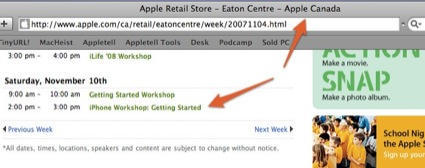
AppleTell grabbed this snapshot off of the Apple Canada website, which seems to announce that the iPhone is finally coming to Canada. Normally, I’d take that as a sure sign that Apple has a product announcement coming tomorrow — Apple loves Tuesdays, after all. But since the MacBook update showed up on a Thursday, I’ll shoot for the end of the week.
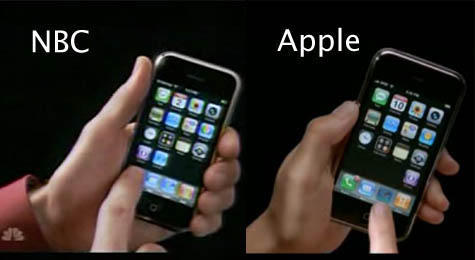
I love the NBC and Apple feud so much. Sometimes, the companies overtly bash each other. For every other moment, there’s fun speculation. Take for instance, the latest volley, which likely has nothing to do with the epic rumble between Jeff Zucker and Steve Jobs, but it’s fun to pretend otherwise. Here’s the set-up: NBC’s Saturday Night Live had a sketch featuring an iPhone that Gizmodo believes to have the illicit installer app that graces all jailbroken iPhones — and then, today, Apple issues iPhone firmware 1.1.2 on UK iPhones, which closes the exploit that enables the current group of jailbreaks. Coincidence? Or distant shots in a hundred-years war?
(No further word on features for 1.1.2. Best not to install for now.)
“Speaking at the CTIA Wireless I.T. and Entertainment show in San Francisco, David Ulmer, senior director of entertainment products at Motorola, says he’s convinced Apple won’t open up the iPhone anytime soon:”
Thanks to Apple’s just-announced iPhone software developers kit, VOIP will likely be coming to the iPhone, according to Alex Schaefer lead programmer of Apollo, a web-based iPhone instant messaging application.
Schaefer is just one of many Mac developers itching to develop for the iPhone. There’s more reaction from developers in this other Wired News story: Developers on iPhone SDK: OMG! ABFT!
After months of speculation, multiple jailbreaks and not a few bricked iPhones, Apple CEO Steve Jobs announced today that a developer’s kit for the iPhone and iPod Touch will be sent out in February, creating a way to add function to the devices through official channels. But he’s still implying that developers will have to jump through hoops to actually get on the platform:
It will take until February to release an SDK because we’re trying to do two diametrically opposed things at once–provide an advanced and open platform to developers while at the same time protect iPhone users from viruses, malware, privacy attacks, etc. This is no easy task. Some claim that viruses and malware are not a problem on mobile phones–this is simply not true. There have been serious viruses on other mobile phones already, including some that silently spread from phone to phone over the cell network. As our phones become more powerful, these malicious programs will become more dangerous. And since the iPhone is the most advanced phone ever, it will be a highly visible target.
Some companies are already taking action. Nokia, for example, is not allowing any applications to be loaded onto some of their newest phones unless they have a digital signature that can be traced back to a known developer. While this makes such a phone less than “totally open,” we believe it is a step in the right direction. We are working on an advanced system which will offer developers broad access to natively program the iPhone’s amazing software platform while at the same time protecting users from malicious programs.
So it sounds truly homebrew apps will get shut out unless starting developers can prove their good intentions. By endorsing Nokia’s new way of doing things, Steve is heavily implying that Apple will stand in between developers and iPhones for our own good. I see his point — virally infected iPhones would be bad for the Apple image. On the other hand, maybe he could just make the iPhone as secure as regular OS X and block access to things like the base band and root folders? Just a thought.
Well over a month after announcing its German and British partners, Apple has finally reached a firm deal to sell the iPhone in France, pairing up with Orange from France Telecom. The device will sell for 399 Euro (almost $575), and the data plans have not yet been announced.
France has been a tough nut to crack for Apple, as the nation has rather robust unlocking laws for cell phones that would appear to run counter to the iPhone’s business model. Only time will tell.