If you’re itching to Zerg Rush with the Windows world, great news coming from Blizzard: the beta to their sequel to the award-winning and still wildly popular space RTS, Starcraft II, will be coming to Macs next week.
It’s a bit belated, since Blizzard released the Starcraft II beta for PC users over two months ago, but welcome all the same. Blizzard is one of the few game developers who take releasing native OS X ports of their games seriously… a strategy which is looking increasingly prescient as Mac marketshare soars.
iFixit is famous for its authorative Apple product teardowns. I just emailed the CEO, Kyle Wiens, with some questions about Gizmodo’s teardown. Here’s Kyle’s take:
Gizmodo emailed me asking the same thing.
I asked them why they didn’t remove the (very removable) EMI shields.
It’s closer to production than I was expecting. I’d say this thing is very very close.
What sucks for Apple is if they have to cut features for some reason. Of course the prototypes would have all the features they’re considering (flash, camera, etc.). But realities force feature removal at the last minute, like they did with the iPod Touch. I’m sure the iPod Touch prototypes had cameras in them.
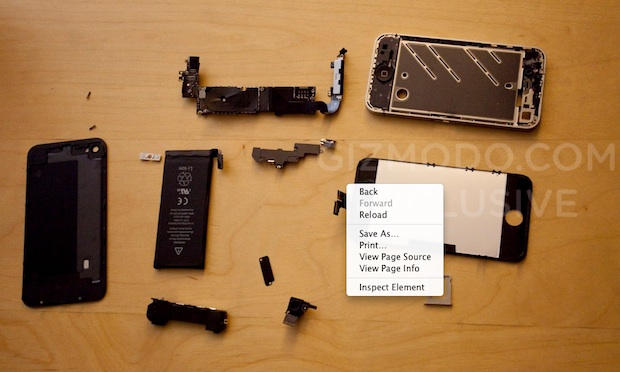
Before returning the iPhone it bought from a guy in a bar for $5,000, Gizmodo performed a teardown. It has just published the results. Unfortunately, it’s pretty uninformative. The teardown reveals the iPhone has a much bigger battery (19% larger), while the rest of the components are much smaller to make room.
The big question — whether the new iPhone runs Apple’s A4 chip — is unanswered because Apple bonded a non-removable metal plate over the motherboard.
The main logic board is one very weird piece of this puzzle… Unfortunately for us, Apple intends to keep this a secret. There are no markings on the board, but even so, the board was encased in metal all around so nothing could get through and would be very difficult to remove without breaking the device. Anyone trying to take this part off the phone would damage the device irreparably. On top of this metal, there was a thermal paste-like material. And on top of that, black tape. They really didn’t want people looking inside.
Obviously, Apple was afraid of this device falling into the wrong hands, which is exactly what happened. One clue whether it runs the A4 is the smaller circuitry. The A4 is a system-on-a-chip, which would require less supporting components.
Apple’s executives dropped several references to “extraordinary” new products during the Q2 conference call, but unfortunately gave little clue what they might be.
Indeed, one Wall Street analyst asked if they were entirely new products, or upgrades to current products.
Peter Oppenheimer, Apple’s CFO responded: “We’re just not going to help our competitors (by talking),” he said.
But he added: “We’re very confident in our product pipeline and very excited about coming months.”
The conference call references reiterate Steve Jobs’ Q2 press release: “… we have several more extraordinary products in the pipeline for this year,” Jobs said.
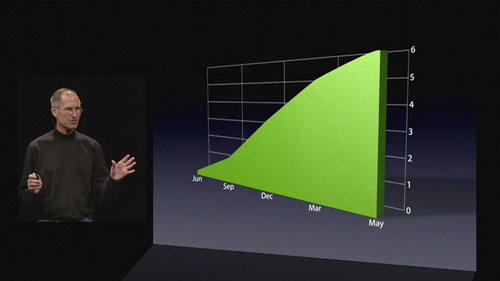
Apple is sweeping up PC switchers and new iPhone users by the millions.
Take the 8.75 million iPhones Apple sold in the March quarter. Add them to the 42.4 million sold at the end of the last quarter. That makes 51.15 million iPhones sold to date. That’s a lot of iPhone users.
Also consider that half of the Macs sold in the quarter from Apple stores were to people who have never owned a Mac.
The March quarter was Apple’s best ever for iPhone sales, racking up more than double the number of units sold in the same quarter last year. Mac unit sales are up 33 percent. Apple is projecting similar numbers for the next quarter.
And there’s no end in sight. On the analyst conference call right now, Apple COO Tim Cook is talking about increased retail distribution points (like Radio Shack) and the massive growth opportunities in China. And all this during a recession.
Apple has settled claims with state regulators who allege the company mishandled electronic waste. Photo: Thomas Dohmke
Apple has just reported record earnings for Q2 2010. Earnings and profits were the best ever for a non-holiday quarter, and sales of Macs and iPhones were up by a big margin. The only blip is iPod sales — down 1 percent year-on-year.
“We’re thrilled to report our best non-holiday quarter ever, with revenues up 49 percent and profits up 90 percent,” said Steve Jobs in a statement. “We’ve launched our revolutionary new iPad and users are loving it, and we have several more extraordinary products in the pipeline for this year.”
Highlights:
Q2 2010 revenue = $13.50 billion
Profit = $3.07 billion, or $3.33 per diluted share. (Last year, revenue = $9.08 billion and profit = $1.62 billion)
Gross margin = 41.7 percent, up from 39.9 percent last year
2.94 million Macs sold (up 33 percent year-on-year)
8.75 million iPhones sold (up 131 percent year-on-year)
10.89 million iPods sold (down one percent year-on-year)
Bill Jordan went to Denver’s Cherry Creek Apple store to buy an iPad for a co-worker as a perk for getting a promotion.
In what may be the most violent iPad theft to date, police say surveillance video shows the 59-year-old Jordan shadowed by two young men who assaulted him before he reached the parking garage.
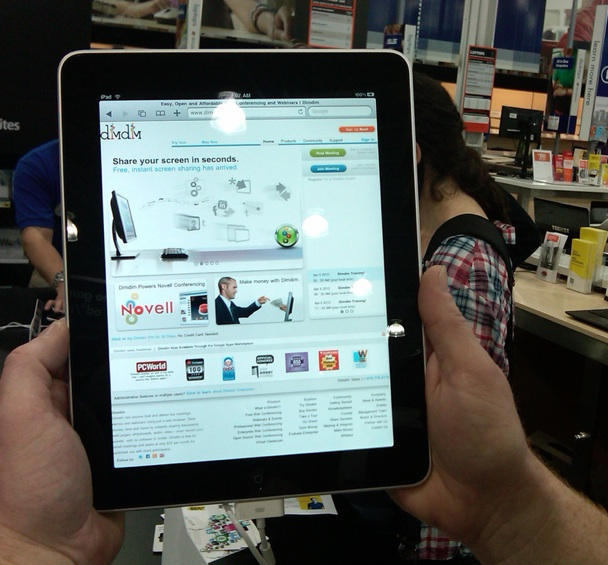
The iPad App Store market may be worth at least $1 billion in two years, according to one developer who did some quick math. That figure could be much higher if the iPad does what the iPhone did to boost App Store sales into the stratosphere.
Vimov, which developed the Weather HD iPad app, estimates Apple is making $136 million per year – or $372,000 per day – just from the top 1,000 apps. That is based on the 500,000 iPads now in the US.
CC-licensed, thanks to Dimdim Web Conferencing on Flickr.
After much speculation about whether 3G iPads pre-ordered in the U.S. might be delayed until early May, Apple cleared up the questions, announcing customers who ordered the devices early will receive them on April 30.
“The Wi-Fi + 3G models of its magical iPad will be delivered to US customers who’ve pre-ordered on Friday, April 30 and will be available in Apple retail stores the same day starting at 5p.m.,” the Cupertino, Calif. company announced early Tuesday.
Ahead of today’s earnings report by Apple, analysts are weighing-in on what we could expect to hear from the Cupertino, Calif. electronics powerhouse. Mac sales were up 25 percent in the March quarter, according to one analyst.
Piper Jaffray analyst Gene Munster estimated Apple sold between 2.8 and 2.9 million Macs during the second quarter, based on the 25 percent figure from retail watcher NPD. Although the sales number was close to Wall Street’s consensus of a 22 percent jump in Mac sales (2.7 million) for the March quarter, the news sent Apple shares down nearly 2 percent in Monday afternoon trading. The reason: The 25 percent sales jump in March was seen as a sign of slowing down from the 43 percent growth in February.
This is the first installment of “My Close Encounters with Steve Jobs,” a fantastic series of stories about the early days of the Mac written by the founder of Macworld magazine, David Bunnell.
Bunnell meets Jobs for the first time. He’s nervous because Jobs is in “an extremely foul mood” says the receptionist, maybe because he had an unsuccessful date with Joan Baez the night before.
Also, Bill Gates tells Bunnell he’s going to buy a Mac for his mother. Gates and his cohorts are so excited about the Mac, they’re all buying up Apple stock (possibly in violation of SEC insider-trading rules).
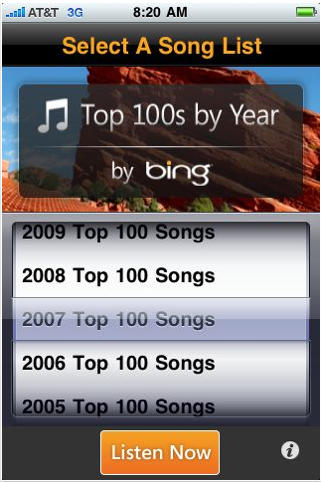
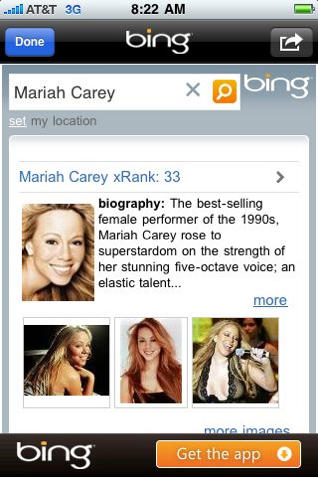
Microsoft and its upstart search engine Bing have partnered with mobile music system developer Melodeo to bring iPhone, iPod Touch and iPad users 100 great songs from every year between 1947 – 2009 – for free. Since coming out earlier in April at $1.99, the app Top 100s by Year has taken on sponsorship by Bing, been transformed into Top 100s by Year by Bing and is now free “for a limited time” on the iTunes App Store.
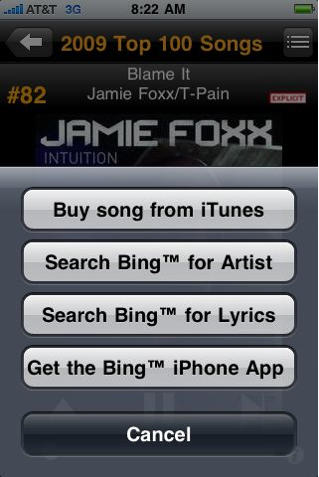
The app allows users to pick any year from ’47 – ’09 and hear 100 “songs that have stood the test of time to become the greatest songs for any given year” (according to the app description), streamed in random order over WiFi, 3G or Edge networks. Users can view a list of songs for any year and listen to a short preview of each, as well as buy the song on iTunes — but listening to songs in their entirety requires listening to the randomized stream. If a distasteful song comes up in the stream users can tap to move on to the next tune.
Bing, of course, offers up ads promoting its search engine every four or five tunes, though ads can be disappeared with a tap.
Another downside is that, unlike listening to songs from an iTunes library on the iPod app, Top 100s won’t permit other apps to run on a user’s device while it’s playing, at least not until iPhone OS 4.0 comes out and Melodeo upgrades the app to take advantage of the new OS’s multitasking functionality.
Assuming that the price of Tiffen’s soon-to-be-released Smoothee iPhone Steadicam would be beyond his budget, Babyology writer Ben Gurnsberg built this amazing iPhone steadicam robotic arm out of spare LEGO Technic pieces.
It looks cool, but how’d it work? Not well, says Gurnsberg.
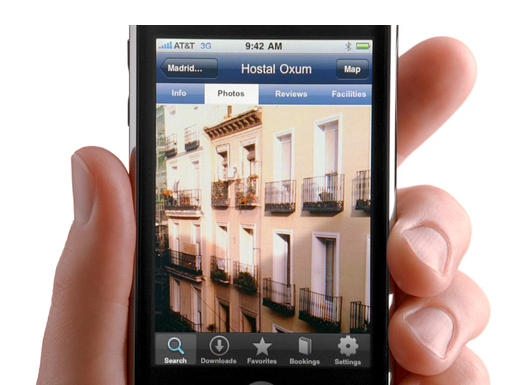
Apple has just unveiled a new iPhone app that, as usual, focuses on taking existing iPhone apps and functionality and applying them to a relatable real-world experience, as conveyed by a pleasant and unassuming narrator.
The “Backpacker” ad follows a young traveler in Barcelona as he uses his iPhone 3GS to find hostels with the free Hostelworld.com application, email pictures to his mom and use the $24.99 Jibbigo app to translate for him on the fly.
Not covered in the commercial? The kidney the narrator had to sell to afford the AT&T 3G international roaming charges he incurred when he returned from his trip. You should have switched to WiFi only, my son.
Inside every iPhone is a moisture sensor: a small dot of liquid-sensitive material that turns bright pink if the iPhone’s insides have been exposed to being submerged. It’s the method Apple uses to protect itself from having to replace iPhones that clumsy customers have dropped in a puddle, their beer or a toilet.
Now a California woman is suing Apple over these moisture sensors, claiming that two separate iPhones died and were then denied replacement by Apple because the moisture sensors had been triggered. The woman, Charlene Gallon of San Francisco, claims otherwise.
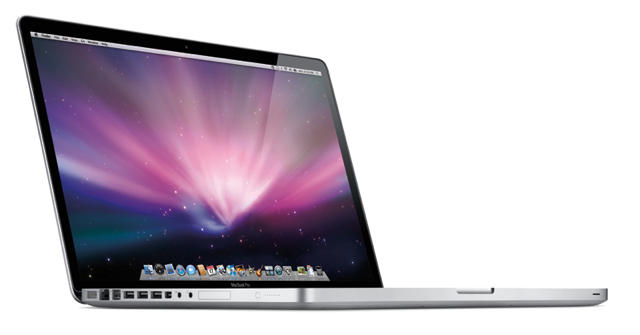
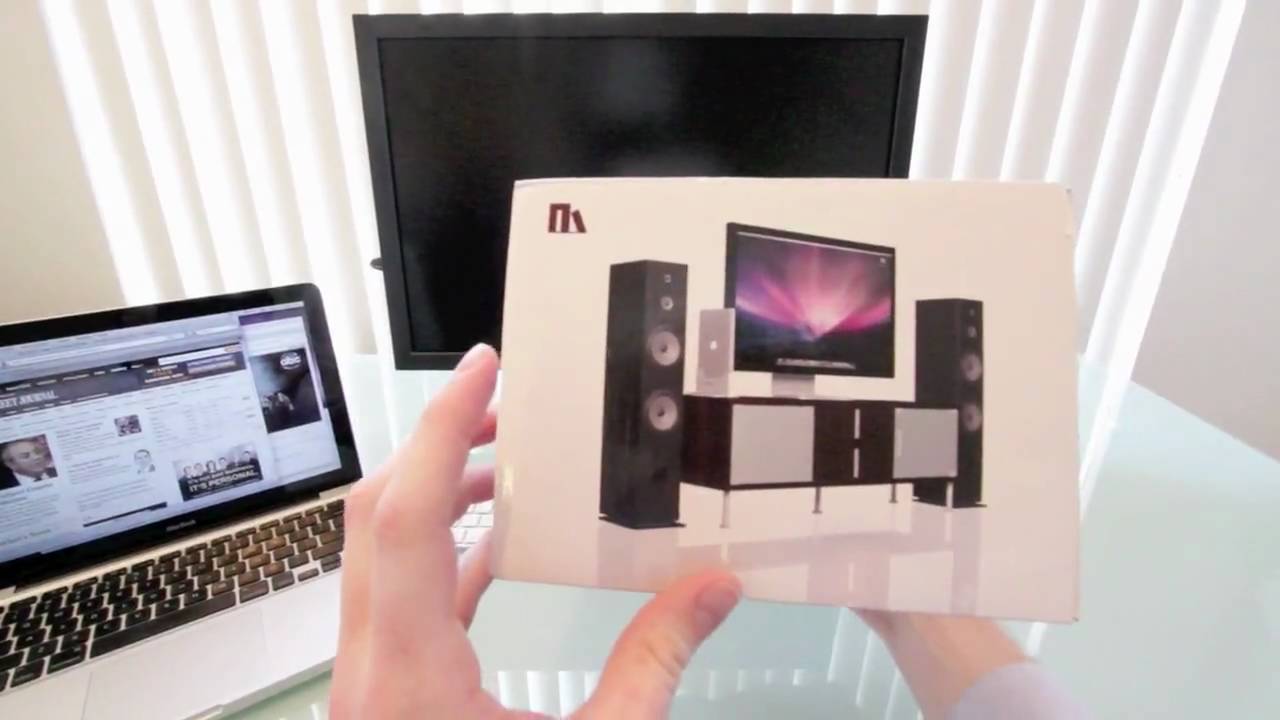
I use my MacBook Pro as my main work computer thanks to a Logitech notebook keyboard stand and an external monitor, but I’ve often wanted something cleaner: a simple and elegant docking solution without any need to manually connect DVI cables and USB umbilicals.
Henge Docks’ line of MacBook docking stations seems to be just solution. All you do is slap your MacBook into the docking station and it’ll drive an eternal keyboard, mouse, printer, hard drive, stereo and any FireWire or USB hard drives you care to connect to it… all in a clean, compact and efficient design. It even uses your existing MagSafe charger.
Very nice indeed, and with prices starting at $59.95, this looks like an easy product to recommend to any Apple fan who uses their MacBook as their main work machine.
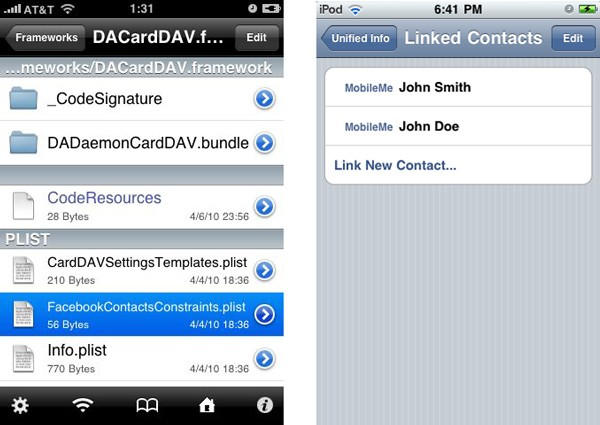
When it was first unveiled at CES 2009, one of the things I really liked about the Palm Pre was its integrated Facebook functionality. Instead of merely adding contacts to your phone manually, you had the option of subscribing to their Facebook contact details, which would automatically merge their phone numbers, email addresses and profile pictures into your local address book.
To me, it represented a much welcome paradigm shift in the way contacts are handled: instead of entering contact details manually, you subscribe to them and have them automatically updated on your handset.
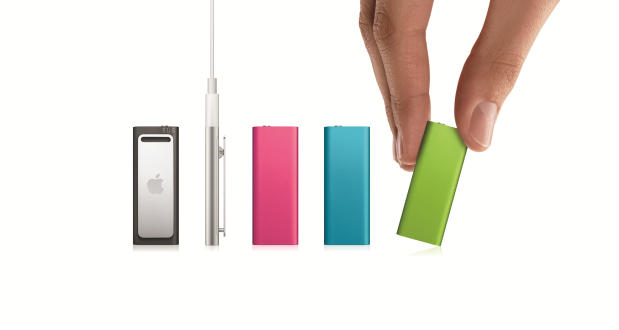
Apple’s perverse obsession with miniaturizing the iPod Shuffle doesn’t seem likely to stop until they bring it down to the size of a nanoangstrom, but one of the biggest drawbacks of making a music player smaller than the controls needed to use it is that the user interface needs to be offloaded to a peripheral: in the third generation iPod Shuffle’s case, the stock ear buds.
It’s a bad approach. The Shuffle was already small enough, and since ear buds tend to be easily damaged, it meant that anyone who owned a Shuffle who lost or damaged their stock ear buds would have to lay out for a replacement pair instead of just plugging in another set of cochleal cans.
From Apple, though, comes slightly encouraging news for third-gen Shuffle owners: they will replace your ear buds free of charge for up to two years if they stop working. Just call up Apple or drop by an Apple Store and they’ll send you off with a new pair of ear buds.
Personally, though, I’ll stick to my second gen Shuffle: an MP3 player the size of a box of matches (as opposed to the matches themselves) is plenty small enough for me already, thank you.
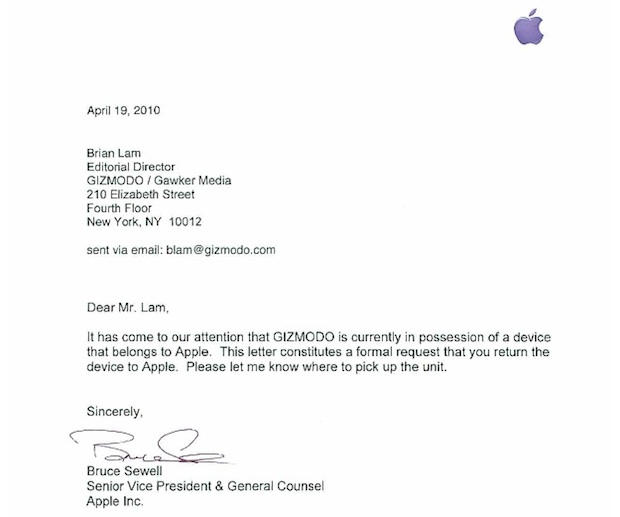
Apple sent Gizmodo a formal letter asking for its iPhone back (proving it was genuine) — and Gizmodo is returning it, along with a nice note asking Apple to go easy on the kid who lost it.
Gizmodo editorial director Brian Lam says Apple called him today asking for its iPhone back. He said he’d be happy to oblige, if he received a formal written request from Apple’s legal department.
He duly received the following:
It has come to our attention that Gizmodo is in possession of a device that belongs to Apple. This letter constitutes a formal request that you return the device to Apple. Please let me know where to pick up the unit.
Sincerely,
Bruce Sewell,
Senior Vice President & General Counsel
Apple Inc.
Lam wrote back putting him in contact with his colleague Jason Chen, who actually has the phone.
Happy to have you pick this thing up. Was burning a hole in our pockets. Just so you know, we didn’t know this was stolen when we bought it. Now that we definitely know it’s not some knockoff, and it really is Apple’s, I’m happy to see it returned to its rightful owner.
P.S. I hope you take it easy on the kid who lost it. I don’t think he loves anything more than Apple except, well, beer.
As well as mentioning that Gizmodo didn’t know the iPhone was stolen when they bought it, Lam also says the guy who sold them the iPhone had earlier tried to return Apple it to Apple. Apparently, he called customer service but go the runaround.
Apple engineer Grey Powell, who lost a test iPhone at a bar while drinking German beer. http://www.flickr.com/photos/termie/4351088476/in/faves-graypowell
The “sorry Apple engineer” who lost a 4G iPhone at a Bay Area bar has been identified as Grey Powell, Gizmodo reports. Powell is a 27-year-old software engineer with a taste for the sauce (judging by his pictures, like this one above with a PBR). He left the test unit at the Gourmet Haus Staudt in Redwood City several weeks ago.
“I underestimated how good German beer is,” he typed into the next-generation iPhone he was testing on the field, cleverly disguised as an iPhone 3GS. It was his last Facebook update from the secret iPhone. It was the last time he ever saw the iPhone, right before he abandoned it on bar stool, leaving to go home.”
Left on a stool, the iPhone was handed to a guy sitting next to Powell. The guy asked around to see if anyone had lost it, but when no one claimed it, he took it home.
When he woke up after the hazy night, the phone was dead. Bricked remotely, through MobileMe, the service Apple provides to track and wipe out lost iPhones. It was only then that he realized that there was something strange that iPhone. The exterior didn’t feel right and there was a camera on the front. After tinkering with it, he managed to open the fake 3GS.
However, Gizmodo does not explain how the iPhone came into their possession — which may be the most important part of the story. “Weeks later, Gizmodo got it,” is all that is said. Gizmodo publisher Nick Denton paid just $5,000 for the iPhone, he admitted to the AP. According to California law, the iPhone is stolen even it was accidentally left at a bar. The finder is legally obliged to return it to Apple. Instead, they sold it to Gizmodo, who at the time of purchase knew it was Apple’s property.
Apple’s next iPhone seems to answer a lot of geeks’ prayers. It’s got a forward-facing camera, a flash unit, and a super high-resolution screen. Combine that with multitasking and and universal inbox in OS 4.0, and who could say no?
Well, plenty of people, it seems. There’s lots of haters out there put off by the iPhone’s boxy industrial design. Many prefer curves it seems.
Let’s put it to a poll. Will you be buying the new iPhone this summer?