Labor protesters demonstrating outside Apple’s Taiwan offices in May. The Apple laptop says “Responsibility.” Images: Global Post.
Asian labor unions will be putting more pressure on Apple on Tuesday with a protest at Computex Taipei, Asia’s largest electronics show.
The unions are hoping to force Apple to intervene in a labor dispute with one of the company’s major suppliers, Wintek, which makes LCD screens and is rumored to be working on the upcoming Mac/iPod tablet.
Wintek has been accused of unfairly laying-off workers and poor and exploitative working conditions in factories in Taiwan and mainland China. Wintek denies the charges.
The protest will “expose the reality to the public, and request Apple Inc. to execute its Code of Conduct, to end the exploitation of labors in Taiwan and China,” one of the unions said in a news release.
The iPhone Blog reports that OS X iPhone 3.0b is now throwing up error messages when you try to ‘redownload’ an app you’ve already bought. You get the option to buy again on your ‘iDevice’, or you can download again for free in iTunes.
Already, forums are up in arms about this (well, forum posters, given that forums haven’t quite arrived at a state of sentience), bitching about Apple being Big Brother and hating every single one of its users. However, it seems like the change is down to users ‘sharing’ apps amongst several Apple devices.
With some devices and games—especially those specifically designed for network play—one might argue that multiple purchases can be somewhat unreasonable from a financial standpoint. (For example, you see plenty of $30+ DS games with broken or severely restricted wireless modes, a problem that magically goes away when every gamer has a cart.) But with the vast majority of App Store games being by indie devs and costing under five bucks (and manyofthebest costing under a single dollar), it’s easier to forgive being ‘forced’ to buy a copy for each device you own.
Along with being a surprisingly versatile device for gaming, reading eBooks and surfing the web, iPhone is becoming an increasingly useful source of distribution for comics publishers. Late last month, ClickWheel, who’ve been in the comics-on-iPods game for a while, released Future Shocks: Part 1, a 99-cent collection of early Alan Moore stories, which was subsequently followed by part two. We caught up with ClickWheel Editor in Chief Tim Demeter for his thoughts on these apps and the market in general.
Cult of Mac: What are the Future Shocks apps and how do they work?
Tim Demeter: The Future Shocks apps are collections of early work from Alan Moore, digitally restored and formatted specifically for iPhone and iPod touch. The apps are entirely self-contained and once downloaded require no cell or Wi-Fi collection to read—you can access them anytime.
How do these apps sit alongside your ClickWheel app?
These are completely separate from our other app. The ClickWheel app is a reader for a multitude of streaming comics, some of which need to to be purchased from the ClickWheel site first. Each Future Shocks app is a one-time purchase. Once it’s downloaded you can start reading right away. Look for a change in how we handle downloading comics to iPhone once the 3.0 software is out there though.
What do you think of iPod touch/iPhone as a comics-reading platform?
We love it. ClickWheel began putting comics on iPods with the launch of the iPod video, so to say that these new devices have enabled us to take our vision of mobile comics to new levels would certainly be understatement. The nice thing about mobile comics is they provide the convenience and immediacy of web-comics while retaining the portability of printed comics. I don’t think printed comics will ever go away and I certainly don’t want them too but I wouldn’t be surprised if many monthlies go digital while the collections remain in print.
What advantages does the App Store bring a company like yours?
People know and trust the iTunes store and many people have a credit card stored in their account which makes impulse purchasing very much a reality. It also seems to be going through the same kind of growth that Amazon did. Back in the day, Amazon was just books. Now it’s just about everything. The iTunes store started as just audio but now it’s TV, movies and apps of all kinds. It’s quickly becoming a one-stop-shop for anything and everything digital and there’s a lot of value in that.
After Jorge Colombo’s iPhone art was featured on the cover of the New Yorker, it seems everyone wants to get their fingers in the pie.
The Brushes app Colombo used to finger paint a late-night scene in Manhattan sold 2,700 copies when the cover debuted Monday, earning slightly over $13,000. It usually sells around 60-70 copies a day.
“A painting app seemed like a natural fit for the iPhone,” 32-year-old Brushes developer Steve Sprang told the NYT Bits blog. “You’re touching the screen, so it’s a natural step to want to draw on it.”
Sprang said the results dwarfed when Brushes was chosen as the app of the day on iTunes and that the app had sold 40,000 copies to date, earning him six figures.
If you’re itchy to get busy with fancy fingerwork, Sprang has knocked the price down a buck, to $3.99, in honor of the New Yorker cover.
A university in Japan is giving out hundreds of iPhones to students, in part to keep truants in check with the GPS system.
Aoyama Gakuin University is handing out 550 3G iPhones to those enrolled in the School of Social Informatics and, much like its growing use in other colleges, it’ll be used as a research tool (press release in Japanese, or semi-comprehensible Google-translated English) and to give out information on class schedules and lectures.
Attendance is a key requirement for graduation in Japan, the AP reports, so the cat-and-mouse game of skipping class and getting someone to sign-in for you or put a hand up during roll call is rampant. The school plans to give out another 500 iPhones for a total of 1,000 to complete the program after a test phase.
Not sure how effective this will be. Students who are determined to sleep in or play hooky could hand the iPhone to a friend and get on with it. Seems easier, and in some ways less deceitful, than getting someone to pretend they’re you or fake a signature.
Would you take the free iPhone in exchange for being monitored?
Photo from the iPhone project press conference courtesy @ Aoyama Gakuin University
Hulu’s newly released Desktop application may or may not put Boxee on the ropes, but it could end up being the best thing that ever happened to the Mac mini.
Released Thursday by the popular television content aggregator whose major partners also happen to be some of the biggest Hollywood content producers, Hulu Desktop signals a major move away from the “online only” model that once served as a thin veneer of protection against the ire of cable companies that pay good money to get content from Hulu’s partners.
Still trying to have it both ways, Hulu issued comical Terms of Service with the desktop product that purport to prevent users from using the software on “Prohibited Devices,” to whit:
“You may not download, install or use the Hulu Software on any device other than a Personal Computer including without limitation digital media receiver devices (such as Apple TV), mobile devices (such as a cell phone device, mobile handheld device or a PDA), network devices or CE devices (collectively “Prohibited Devices”).”
In the real world, however, don’t be surprised to see news of an AppleTV hack by this weekend (if not before); and Mac mini users who employ that device’s excellent media server capabilities with a connection to plasma screens in their living rooms should be sitting pretty, too.
Will you use Hulu Desktop or stick with your web browser? Will you keep the content on your computer screen or take it into the living room? Let us know in comments below.
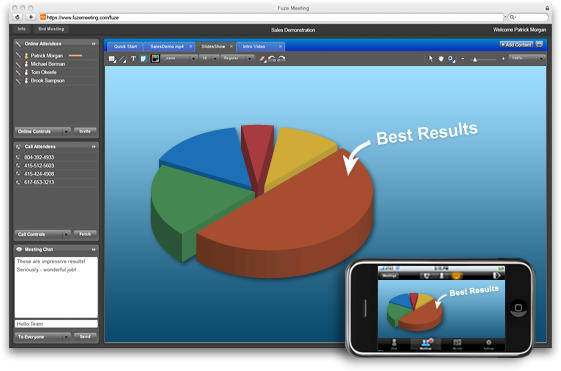
Web conferencing provider Fuze Meeting is sponsoring a SlideShare contest in which the Grand Prize winner will walk away with $5,000.
All entrants in the “Tell a Story in 30 Slides or Less” contest will get a free Fuze Meeting account for a year — a $270 value – and 4 runners-up will get an iPhone + $100 iTunes Gift Card.
The contest will be judged in 4 Categories:
1. Best Design
2. Best Story Telling Ability
3. Most Popular
4. Best Use of Multimedia
Closing date for entries is Monday, June 15 and winners will be announced June 29.
Apple’s Retail division has no plans to scale back its ambitions, according to a report Thursday in USA Today, and in fact sees opportunity in the recent economic contraction.
“We’re investing in the downturn,” said Ron Johnson, Apple’s senior vice president of retail. Apple plans to remodel 100 of its existing stores this year, adding space for customer training and room for displaying more product. The company also plans to open 25 new stores, including a fourth location in New York City, and new ones in Paris, Italy and Germany.
Stores will soon display “twice the amount” of Mac computers and other products, according to Johnson, and Genius Bars will get 50% more room to serve up free tech support for Apple products.
Beginning June 2, Apple’s One to One product training program will limit sign-ups to purchasers of new Mac computers at Apple Stores or via the company’s website, although any of the half million current One to One subscribers will be able to renew their $99 one year subscriptions .
“We originally set up One to One to get people to switch to the Mac,” Johnson said. “Now we want to expand it to make it even more relevant to people who have bought their Mac.”
Still priced at $99, the annual subscription includes personal setup, transferring of files from an older computer (Windows or Mac) and help with projects.
Previously, sessions timed out at one hour; new policy will extend the limit to three hours, but sessions could also include up to three participants.
Even in the light of his division’s expansion plans, Johnson conceded the recession has affected in-store traffic. Apple reported a 3% decline in sales during the most recently reported quarter. Traffic remains strong, he said, but has cooled off since last summer, when long lines greeted the introduction of the second-generation iPhone.
With many expecting an update to the iPhone to be announced at next week’s WWDC in San Francisco, Apple stores could well see the return of long lines and a need for all that extra space.
Flickr user jumbledpile (nichole) offers pics of a unique iPod meatloaf ‘birthday cake’ made by her friends Amanda and Carlos, which has to be as notable for floating the idea of a birthday cake made from meat as it is for its homage to Apple’s iconic MP3 player.
With creamy mashed potato ‘frosting’ layered over a tasty center of seasoned ground beef, the meatcake comes with cheesy earbuds and pea decorations arranged to suggest the iPod control wheel and personalized data screen.
Easily serves a party of 6 – 8 Apple fans like peas in a pod. Sorta.
However, Woz said he’s never asked Jobs directly about his health.
Jobs is expected to return to Apple at the end of next months after taking six months medical leave to concentrate on his health. In a January letter to Apple’s employees, Jobs said his health issues “are more complex than I originally thought.” He lost an alarming amount of weight in 2008, leading to speculation his cancer had returned. Jobs was treated for pancreatic cancer in 2004.
Engineer and programmer Steve Capps, who worked on Lisa, the Finder and Macintosh system utilities, talks about his work on the original Macintosh team with the guys at RetroMac Cast in a two-part podcast (episodes 115 and 116).
Capps got started by automating a library in college, then went to do the same at Xerox before landing at Apple in 1981. He was chosen to work for the Mac team because he had “the right chops at the right time.” Capps was working on a printer drive for the Lisa team, when Steve Jobs lost interest in Lisa and put the steam behind the Mac, calling Capps over.
“Great to talk about the old glory days,” Capps, who went on to work on Internet Explorer and MSN Explorer, said.
The rollout will begin later this year, AT&T says. The company also promises it will “introduce multiple HSPA 7.2-compatible laptop cards and smartphones beginning later this year.”
One of the smartphones is likely Apple’s next-generation iPhone. Apple is expected to introduce a faster iPhone that will support HSPA 7.2. The new iPhone will also likely have a faster processor, which will be better able to handle the faster data stream, quickly updating content like web pages and maps.
CrossLoop, the Monterey, CA-based developer of a popular screen-sharing application for PCs announced this month a version compatible with Intel Macs, extending the company’s innovative on-line technical support model to the Apple community.
Having racked up over 100 million minutes of tech-support served by nearly 5 million downloads of its PC client since 2006, CrossLoop is now seriously targeting the universe of Mac users and even pitching the product as a perfect vehicle for helping PC users switch to Mac.
While a great percentage of the peer-to-peer help sessions done with CrossLoop are free (downloading the software is free and there is no charge for users to share their computer screen with other CrossLoop members), the company’s platform supports a community of nearly 15,000 registered “helpers” whose freelance technical support can be had using the service for between $50 – $60 per hour.
CrossLoop competes in a field with larger (Citrix) and better known (Geek Squad) names, but is currently logging a quarter million screen-sharing minutes a day and looks to be in the game for the long haul. If you are looking to help a friend remotely with a software install or considering freelancing your tech support skills on the side, CrossLoop could be well worth a look.
US college students and teachers who buy a Mac get an iPod Touch thrown in a back-to-school promotion. (Fine print: you have to buy before Sept. 8 and shell out the cash for the iPod touch, which you get back via rebate. Full details here.)
The ad shows a cheerful student whose iPod Touch displays “Monopoly” but with the iPod Touch being used more frequently in colleges for orientation, class lectures and in some cases required or in place of textbooks having one is becoming less of a plus and more of a necessity.
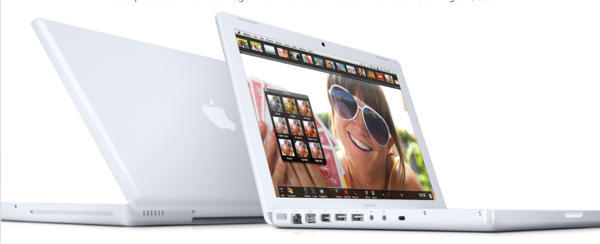
Apple’s entry-level white MacBook received a hardware update on Wednesday, possibly foreshadowing revisions to the aluminum unibody MacBooks.
For the same $999 base price, the WhiteBook now gets:
* CPU bump from 2.0 GHz to 2.13 GHz.
* Hard drive from 120 GB to 160 GB.
* RAM boost from 667 MHz to 800 MHz.
*Battery life upped from 4.5 hours of “wireless productivity” to 5 hours. And now rated Energy Star EPEAT Gold, up from EPEAT Silver.
Thanks to the updates, the WhiteBook now has a faster processor than the entry-level aluminum MacBook, and a bigger build-to-order hard drive (500GB). And it still has a FireWire port. Updates to the unibody soon?
Apple is rumored to be offering similar upgrades to the aluminum MacBooks at WWDC, and rebranding the machines as MacBook Pros to further distinguish them from the white plastic MacBook.
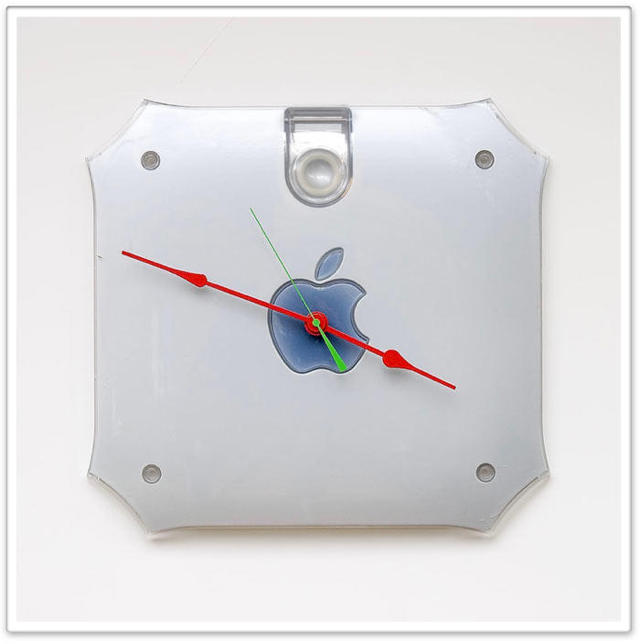
Can you think of another company whose outdated and obsolete products get repurposed as art pieces even a fraction as often as do those from Apple?
How about a late 20th century PowerMac G4, which, as a 10 year-old desktop might possibly still be good enough to run your elementary school children’s games and learning software, but for all practical purposes is probably better suited as the inspiration for a wall clock to remind you, time after time, how gear Apple cool is.
At a mere $60, these may not last long and you should look into turning your own dusty G4 into a DIY project.
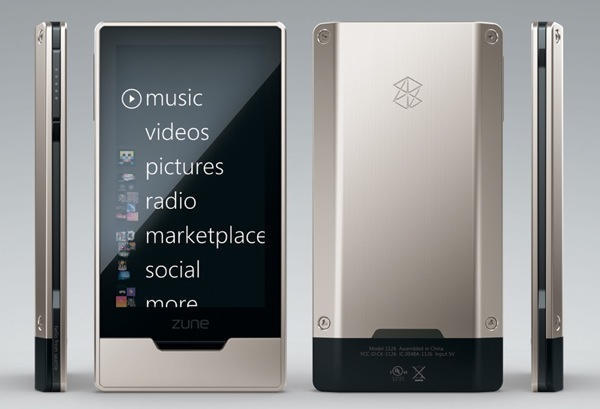
Microsoft will release a Web-surfing, HD-video-playing, multitouch Zune in the fall to compete with the iPod touch — and the hardware actually looks pretty cool. But as Apple well knows, the gadget is one thing, the software and services are another.
Sporting a sexy metal case, the Zune HD will have a 3.3-inch, 480 x 272 OLED capacitive touchscreen display (16:9 widescreen); a built-in HD Radio receiver, and WiFi. The “HD” refers not to the touchscreen, but the HD radio and HD out (720p), though that’s only available with an optional cradle. Pricing was not released, and release is “early fall.”
The cover of the June 1, 2009 edition of the New Yorker magazine will feature art composed completely on an iPhone for the 1st time, according to multiple reports Monday.
Artist Jorge Columbo used the iPhone app Brushes to “fingerpaint” a street scene of people gathered by one of the city’s iconic hot dog & pretzel carts, elevating art on the iPhone to yet one more level of acceptance few could have imagined when Apple’s mobile device first came to market less than two years ago.
Hit the jump for a video made with the Brushes companion app Brushes Viewer showing just how Columbo used Brushes to create his work.
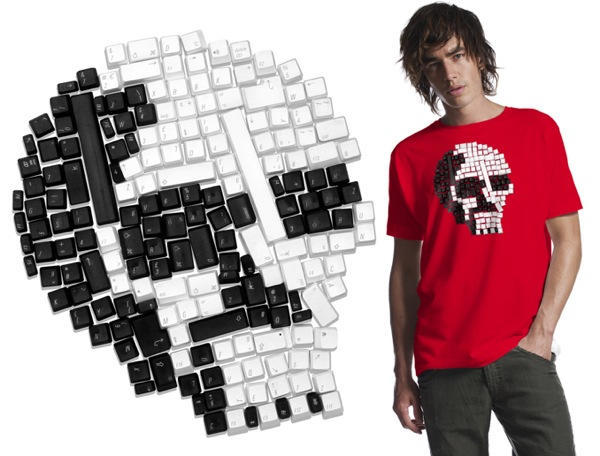
It’s a classic skull design, made with the keys from a pair of Apple keyboards. The white keys come from an extended white Mac keyboard; the black keys were taken from the original iMac (the one with the half sized F keys). Says Roger:
“I could say it depicts the obsolescence that all computer equipment faces, but really it’s just skulls make great tees! What Mac geek wouldn’t like to see a design featuring Mac keys, and only only closer inspection can you find the classic Apple command key.”
Hit the jump for a bigger picture of the skull — and the elusive command key.
However—and this is important—flagrant and blatant IP infringement is apparently fine, judging by Luigi Vs Pac.
And, yeah, we know Apple shouldn’t have to be the IP police when it comes to App Store content, and that some properties being ripped off are somewhat obscure. But, c’mon—Luigi and Pac-Man? In one game? Oh dear.
Apple’s Safari 4 browser is a pig. It’s a resource hog that doesn’t clean up after itself — and it remembers every site you visit, even in “porn mode.”
Safari records every site you visit, even if you turn on the “Private Browsing” feature or clear the browser history. And the files it generates can consume gigabytes of disk space.
“This is a huge privacy concern,” writes designer and musician C. Harwick, from Chapel Hill, NC, who did some snooping in Safari’s hidden system folders. “With no good way of getting rid of them except manually (clearing the history doesn’t do it, and I don’t think resetting Safari does either), these hidden files are strewn all over the user’s hard drive unbeknownst to him waiting for snooping relatives (or more pertinently, law enforcement) to dig them up. I really like Safari, but I’m going to have to seriously consider using Firefox now (ack).”
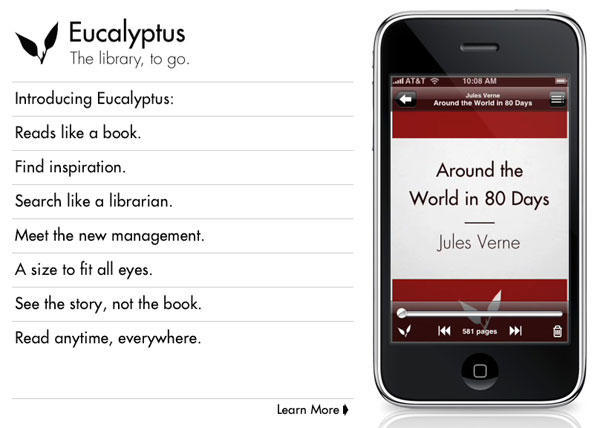
Who says Apple doesn’t listen to customers? Thanks to a public outcry, Apple has reversed course and accepted the Eucalyptus eBook reader into the iPhone App Store.
The web erupted in outrage last week when developer Jamie Montgomerie’s eBook reader was rejected by Apple because it allowed readers to download the Kama Sutra from Project Gutenberg — which Apple deemed “inappropriate sexual content.”
But on Sunday Montgomerie received a call from Apple. The Apple representative chatted with the developer about his app and invited him to resubmit it.
“We talked about the confusion surrounding its App Store rejections, which I am happy to say is now fully resolved,” Montgomerie wrote on his blog.
David Leibowitz is a veteran fine art photographer who’s lately been making some pretty amazing art using his iPhone.
Based in NYC, Leibowitz’s pictures of the city look like a French Impressionist painted the scenes (hit the jump for more pictures). There’s nothing to indicate they were made using his iPhone and about $40 worth of apps from the App Store.
Leibowitz has a long history of using digital tools to make art. He started in the ’80s with a Polaroid camera. He’d hand manipulate the emulsion to create photographs that look also look like Imrpessionist paintings. But now he’s discovered the iPhone, and the results are not your typical iPhone art.
Hit the jump for some of Leibowitz’s latest pictures and an interview explaining how he makes iPhone art.
Solar power has been an obvious answer to many of the world’s daunting energy challenges for a long time, but the expense and relative bulk of solar panels have largely kept solar out of the running when it comes to solutions for mobile power.
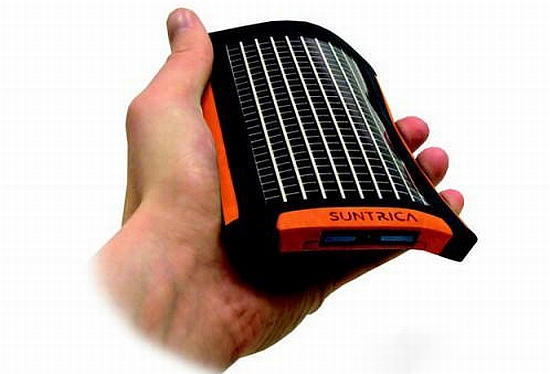
Suntrica, a nordic eco-tech company, seems to have found a solution, though, with a line of charging solutions that are small, light, and flexible and could be just the thing energy conscious consumers are looking for to power their gadgets to go.
Suntrica’s SolarStrap™, SolarBadge™ and SolarBadgePRO™ use a flexible, high-efficiency solar panel connected to internal, lightweight batteries for instant or later use. Battery capacities range from 3.7Wh to 7.3Wh and the output of all the chargers is 5.5V DC at 800mA, which makes them perfect for all your portable electronic gear.
Current models are compatible with Apple iPod and Nano, though the company plans to release iPhone compatible chargers in the next couple of months.