In a not-terribly-surprising report, the Wall Street Journal notes that Mac sales were down 6 percent year-over-year in January, the first time that’s happened in three years.
This shouldn’t be terribly surprising — Apple only introduced the 17″ MacBook Pro in January, which is a niche product that is only now shipping. Beyond which, Apple makes expensive computers, and all computer-makers are seeing sales drop, including those who make the cheap-o ones.
From what I can tell, the only category enjoyed sales increases at the moment are Netbook makers. Maybe it is time Apple looked into that, eh?
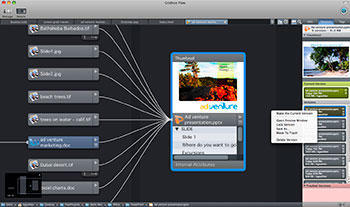
Gridiron Software released Thursday the much anticipated free public beta version of Flow, software for the Mac the company calls a Visual Workflow Manager. In short, Flow brings order out of chaos and, if first impressions mean anything, is apt to be the most transformative productivity tool anyone has seen in quite a while.
Many talented and creative people are not wired for total top-down organization and don’t hard-code cross-referencing and version tracking into their work on projects. As a result, a lot of frustration and lost time can accompany efforts to complete work to its final delivery state.
Flow lets you get out of your own way, automagically tagging and tracking everything that goes into a project, from idea to end result. Users can see how all the pieces of a project fit together, in one interface, and access them instantly, even if they are offline.
The built-in, automatic time-tracking feature is bound to be received as a godsend by those responsible for budgeting and billing and Flow collaboration enhancements promise to increase productivity by helping you work smarter, not harder.
For the guided tour demo of Flow’s amazements go here.
The first version is for Intel Macs, with support for PowerPC and Windows coming soon. Download the free beta here and when you decide to buy the promotional price of $249 is good until May 1. After that, the price will be $299.
“Wheels on the Bus” is an iPhone app in five languages, based on the nursery rhyme, with extras like instruments kids can play and a recording feature, hopefully providing hours of entertainment for kids and perhaps a bit of respite for parents.
My only reservation about the app, named “Staff Favorite” in iTunes and currently the number two paid education app, comes from the song itself, perhaps one of the most annoying kiddy tunes to ever hammer itself into the tired brains of parents. A friend of mine with a two-year-old daughter was so fed up with the ditty (the doors on the bus go open and shut, open and shut) that “Wheels on the Bus” became shorthand for “Mommy needs a few cocktails or something bad will happen.”
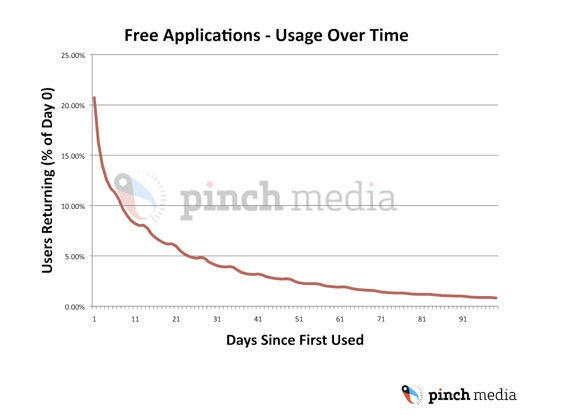
A new study highlights what could be the iPhone version of attention-deficit disorder. A day after a free iPhone app is downloaded, there’s only a 20 percent chance it will used.
Possibly more disconcerting for Apple and iPhone developers: just 5 percent of free apps are used one month after downloaded – and nearly no free app is used after three months , according to data compiled by Pinch Media.
The tracking data was announced at an iPhone Developers Meetup in New York by Pinch Media CEO Greg Yardley.
A small study indicates that students who listened to podcasts remembered more than those who attended lectures.
The study, as reported in New Scientist, tested 64 students on information retention.
To see how much students can learn from podcast lectures alone, students were given a single lecture on visual perception from an intro psychology course.
Half sat through a live lecture and were given printouts of the slides used. The other 32 downloaded a podcast that included audio from the same lecture synchronized with video of the slides. These students also received a printed handout of the material.
Another photo of a supposed Apple Mac Mini prototype has surfaced online. The image could give a glimpse into Cupertino’s as-yet unannounced refresh of the popular desktop computer.
The photo shows Apple may be considering beefing up the ports, including adding a fifth USB connection, retaining its mini DVI port as well as its recently-introduced Mini DisplayPort and swapping out a FireWire 400 port for the newer FireWire 400 connection.
“This is the second picture of a Mac mini seen by AppleInsider with such a port makeup, the first of which we were asked not to publish,” the news site told readers Friday. The first photo was described as a prototype from late 2008.
The folks at Omni got a mysterious gift via email the other day: a script that hunts through an iPhoto database for Faces, and relationships between them.
Then it takes what it’s found and spits out an OmniGraffle document showing which people appear in photos together. The result is this weird spidery diagram.
Judging by the comments, some people have had problems getting the script (created by Armin Briegel) working. An updated version has been posted, though, so it might still be worth a try if you have OmniGraffle installed.
This is a neat little trick, so I wonder how long it will be before we get something like this functionality inside iPhoto. After all, it’s already possible to use Places as a criterion for creating Smart Folders – with any luck, a future update will add Faces to that list. Then it would be possible to create Smart Folders that contain two or more particular people.
I’m not sure which this post is more in favor of: Camino (The World’s Best Browser) or Dropbox (The World’s Best Sync Thing), so let’s just say we love both of them and get on with it.
The marvellous Mac OS X Hints has a hint for Camino/Dropbox users everywhere: how to sync Camino via Dropbox. Which makes a great deal of sense if you use Camino on more than one machine.
Camino, like Firefox and other ‘zilla-based browsers, stores all its stuff in a profile folder on your hard disk. Normally that profile is buried in your Library/Application Support folder, but you can move it to your Dropbox folder and with a tiny bit of Terminal-fu, link the one place to t’other. Camino carries on its merry way, and any changes it makes to the newly-relocated profile are invisibly and promptly synced to your other machines thanks to the incredible magic of Dropbox.
I think this is the aspect of Dropbox that makes it so much more appealing than other sync services I’ve used in the past: Dropbox doesn’t act like an application, it acts like just another folder on your system. It works with and inside the Finder, no messing about, no having to remember to do anything (like click a button marked “Sync”).
Have you ever tried reading in the car and gotten a headache, or even sick to your stomach? For just 99¢ you can get that feeling anywhere, any time with SkyCoaster 3D on your iPhone or iPod Touch.
SkyCoaster 3D makes effective use of panoramic photography by Gavin Farrell and iPhone’s 3D rendering engine to create a fully customizable rollercoaster experience right on your mobile device. Users can tweak parameters such as height, track length, and acceleration, as well as adjust the ride’s loop-the-loop, corkscrew and downward spiral effects.
The app comes with a built-in techno soundtrack to heighten (or, if you prefer, enhance) its vertiginous effects, or a track from the device’s iPod can be used. The precise map of every ride is randomly generated, so each ride is unique.
Barf bags sold separately.
UPDATE:v1.1 of SkyCoaster 3D released early Friday and v1.1 makes it even easier to induce barfing. The track is more detailed (with links that run perpendicularly to the rails), which gives a greater sensation of speed. Also, you can look around during the ride, and even ride the roller coaster with your back facing forward.
Teens are apt to disregard requests (and even orders) from their elders and will often turn the volume on their iPods louder when told to turn it down, according to a new study published by the Colorado Daily Thursday.
Shocking inferences of teen rebelliousness and even disregard for their own hearing health come from a University of Colorado study of 29 metro-area Denver teens who participated in a survey about their iPod use and attitudes toward music.
A 2006 study conducted in Boston by Cory Portnuff, now a CU audiologist and doctoral candidate, showed listening to iPods on maximum volume for more than 5 minutes a day increases one’s risk of hearing loss. Portuff’s new study confirmed long-held suspicions such as:
* teenagers who feel like they wouldn’t enjoy their music as much on low volume tended to listen loud
* teens turn up their iPods to drown out the soundtrack of the surrounding environment
* teens who indicated the most concern about hearing loss from iPods played their music louder than their peers.
While no one in the study preferred the highest volume, the evidence showed between 7 percent and 24 percent of the teens listened to their iPods and MP3 players at risky levels, and boys listened slightly louder than girls across the board.
The Cult team members are not famous for colorful desktops, but when I saw this little beauty I felt it deserved some link love. This gorgeous desktop picture (and its slightly spikier sibling) are now available for free from the generous hands of Wolfgang Bartelme, having recently made something of a splash of their own on Flickr.
Wolfgang is no stranger to design gorgeousness, having also created other desktop and iPhone wallpapers like Dashball, ColorFlow, and ColorFlow 2.
A Spanish pickpocket may be among the first to beta test Microsoft’s answer to the iPhone and Google’s open-source Android mobile software. An Australian telecom chief reported the theft during the Mobile World Conference wrapping up today in Barcelona, Spain.
The prototype phone and a copy of the yet-unreleased Windows Mobile 6.5 was taken from the pocket of a Telstar executive. Microsoft lent the prototype to Telstar’s CEO soon after announcing Windows Mobile 6.5 at the Mobile World Conference.
“One of our product executives was given the phone to test the system. He had it with him at an organized evening event and it was stolen from him,” a Telstar spokesperson told the London Telegraph.
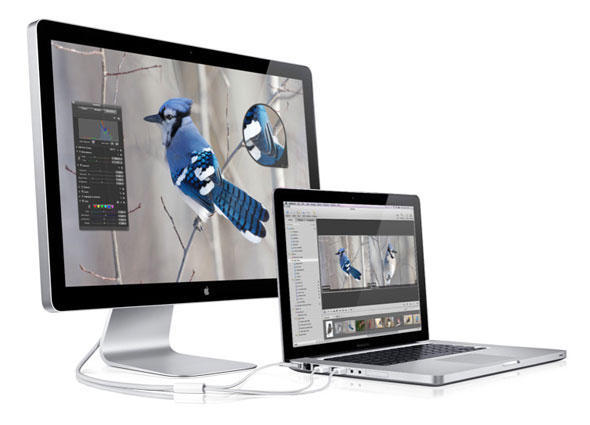
Now there are two. Apple Thursday told service agents it will no longer support the 20-inch Cinema Display, leaving its new 24-inch LED Cinema Display and older 30-inch version as the only external display options.
In a bulletin, Apple said the 20-inch Cinema Display had reached its End of Life. As a result, the Cupertino, Calif. company would cancel any pending orders.
The news prompted speculation Apple may soon end support of the 30-inch display, leaving just the new 24-inch LED display designed for Apple laptops.
More consumers are satisfied with Apple computers than products from PC makers, indicates a new survey. The Cupertino, Calif. company registered 81 percent consumer satisfaction compared to 67 percent for its nearest PC competitor.
The survey by ChangeWave Research asked customers who had purchased a computer in the past 90 days whether they were very satisfied, somewhat satisfied, unsatisfied or very unsatisfied with their choice.
Apple garnered an 81 percent “very satisfied” rating, while PC maker ASUS earned a 67 percent “very satisfied” ranking. Acer received a 61 percent satisfaction rating while 56 percent of Sony customers were very satisfied.
Wired founder Louis Rossetto’s new business, artisan chocolate company TCHO (technology + chocolate) lives up to its name.
The San Francisco chocolate plant is full of industrial hacks, including common kitchen gadgets, like turkey roasters and curry mixers, a $40 space heater from Walgreens and a dryer duct. (Take a peek inside the chocolate works with a video).
Where does the iPhone come in? Tcho founders commissioned an automation software to allow for 3-D monitoring of the labs from the device.
They’ll be checking on a new kind of fermentaria, boxes used to naturally ferment cacao, developed by former Nasa scientist Timothy Childs.
“In Peru, we’re setting up weather and fermentation monitoring and sensory analysis. We are putting temperature probes in the middle of fermentation boxes,” said Childs. “We are creating a baseline of data. We are telling farmers to charge us more for beans when they get it right. We are saying, ‘If you go from 60 percent fermentation to 72 percent, we will pay more.’ We want better uniformity in fermentation.”
Just Tuesday we reported on the sad news that Apple decided a South Park iPhone app that allowed downloading of episode clips would be “potentially offensive,” and so barred it from distribution in the AppStore.
Here’s a how-to video for all the jailbreaking criminals out there who just can’t live without South Park on the iPhone.
Dude has pretty good taste in music and a very easy-going instructional manner. If you’re willing to flaunt “the law” he shows you how to download South Park episodes to your iPhone and even how to put ’em on your PC.
The bottom line to the story here is clear: after Friday Boxee users will no longer be able to stream Hulu content through Boxee’s media center platform.
What’s less clear is who holds the cards in the deal — is it Boxee, Hulu, or the content providers on whom both of them depend for existence — and who will win in the end.
As usual, consumers, at least in the short run, get the short end of the stick.
Hulu CEO Jason Kilar put the best face on things in a blog post Wednesday, saying, “we stubbornly believe in this brave new world of media convergence,” while admitting that without Hulu’s content partners’ content “none of what Hulu does would be possible.”
A Boxee spokesman told Cult of Mac, “our goal has always been to drive users to legal sources of content that are publicly available on the Internet.” He said as a bridge between the converging worlds of traditional and online media Boxee can be a revenue generator for both content streamers such as Hulu, as well as for original providers. “We have many content partners who are generating revenue from boxee users and we will work with Hulu and their partners to resolve the situation.”
For now, after accounting for the cost of a robust internet connection, consumers can still access content from Netflix, ABC, CBS, MTV and more for free. But where Boxee will fall in the ongoing scrum for ever-tightening consumer dollars among cable providers and network content producers remains to be seen.
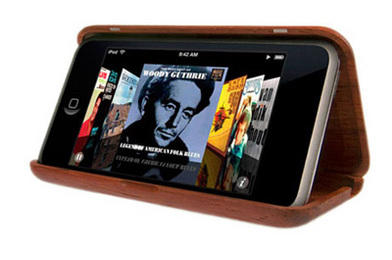
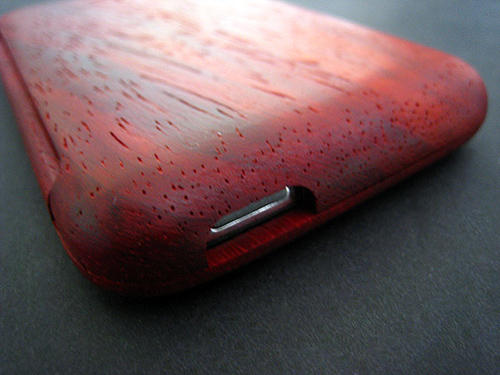
These simple, sleek iPod touch custodians made of wood also double as stands.
These Dutch-designed cases are called iWood Touch (what else?) they’ll set you back about $100 (€80). Miniot offers them in four different types of wood ( cherry, oak, padouk – the reddish Asian wood pictured above — and walnut) for first gen iPod touches and two for second gen (just padouk and walnut). They’re a little pricey, but have the advantage of looking enough like an eyeglass case that they might thwart a thief or two. Your monogram or short message of love are carved into the case as part of the price.
If you find wood is good, new two-tone versions of their iPhone covers are also available, though these do seem to clunk up the design of the device a bit.
Owners of Apple’s iPhone should not hold their breath waiting for a version of Flash for the favorite handset. Adobe is now reticent to talk about whether it was working with the Cupertino, Calif.-based company.
“Adobe needs more from Apple to succeed than Apple ordinarily makes available to iPhone software developers,” Dow Jones wrote Tuesday after talking with an Adobe spokeswoman.
The refusal by Adobe to comment on its relationship with Apple caused one Apple fan site to pour cold water on previous suggestions the two companies were working closely on an iPhone version of Flash.
Cult reader Flunky Carter shares this interesting survey of his iPhone shot using a webcam’s Night Vision.
Small cracks and stress fractures he says are not visible to the naked eye under normal lighting conditions show Apple’s mobile device takes significant wear and tear in the real world.
Although the economy has caused it to curtail opening more retail locations in 2009, Apple Wednesday officially added France and Germany to its list of European stores.
Two locations appear to be vying for the spot as Apple’s first storefront in Paris. The most well-known is one slated in the Carrousel du Louvre, a mall nearby the famous Louvre museum. However, a store is also on the drawing board situated close to the Paris-based Garnier operahouse, according to reports.
Following its Paris premiere, Apple is expected to launched another French store in Montpellier.
During bleak economic times, companies need to welcome the faintest rays of sunshine. That appears to be the word from one analyst forecasting lower sales for Apple’s upcoming March quarter.
“We believe this data will be perceived as a neutral or a slight positive given the uncertainty surrounding the Mar-09 quarter,” Piper Jaffray analyst Gene Munster told clients Tuesday.
Sifting through numbers from NPD and internally, Munster expects -6 percent growth for Mac sales, compared to the second quarter of 2008.
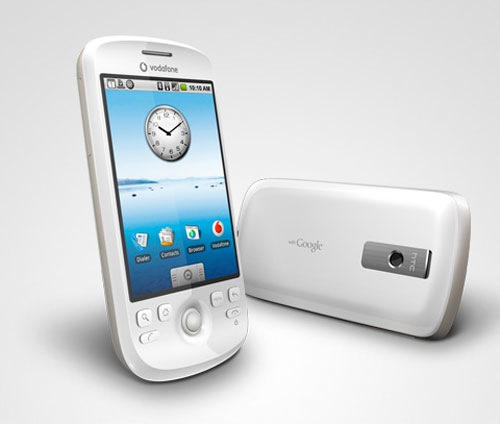
Cell phone maker Samsung Tuesday added its name to the growing list of manufacturers joining the Android bandwagon. The company said it would unveil at least three handsets based on the open-source Google mobile phone platform in 2009.
In a Reuters interview, Samsung’s product strategy chief, Won-Pyo Hong, said ‘at least three’ Android phones would be produced, the first appearing in the later half of this year. Previously, the No. 2 cell phone maker had said its Android phones would appear in the Spring.
Although the company released few details, talk has surrounded Sprint and T-Mobile as the handset’s U.S. carriers.
There are many co-workers who would be wise to read this message before approaching, just wonder if over time, they’d start pretending you hadn’t declared yourself the resident grouch.