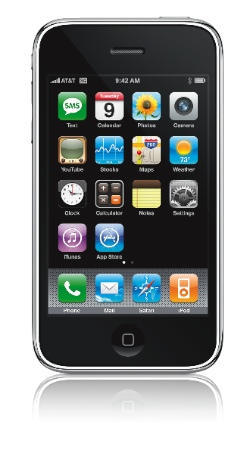
The battle to bring the iPhone to Taiwan became a bit more crowded as that Asian nation’s top carrier announced it will start selling iPhone service “before the end of the year.”
December is the tentative launch date for exclusive sales deal, Digitimes reported Monday.
In a brief statement released over the weekend, Chunghwa Telecom said it “has signed a contract with Apple, and it will provide third-generation iPhone services in Taiwan before the end of the year,” according to the Dow Jones News service.
We’ve written before about some of the creative ways Mac users act to protect their gear and to foil the nefarious intentions of would-be thieves. This week brings another, called MacTrak, from GadgetTrak, Inc., makers of the new anti-theft software for mobile devices.
MacTrak features location-awareness from Skyhook Wireless’ Wi-Fi Positioning System (WPS) and integration with Flickr to capture the location and images of laptop thieves.
“Skyhook’s cutting-edge location technology allows our software to send the location of the device to the owner along with a photo of who is using the system, greatly increasing the chances of getting the stolen device back,” says Ken Westin, founder and CTO of GadgetTrak.
When a MacTrak-enabled laptop is stolen, the device owner can remotely activate tracking for their stolen system. Once the stolen device connects to the Internet, MacTrak determines the device location using WPS. It will also activate the Mac’s camera and photograph whoever is using the device. The image, location and network information are then uploaded to Flickr and an email is sent to the owner with the same information. Data will continue to be sent over time until tracking is disabled.
“Skyhook’s Wi-Fi Positioning can pinpoint the location of a stolen device within 20-30 meters even in dense urban areas or indoors, meeting the tough performance standards of security applications,” says Kate Imbach, director of marketing at Skyhook Wireless.
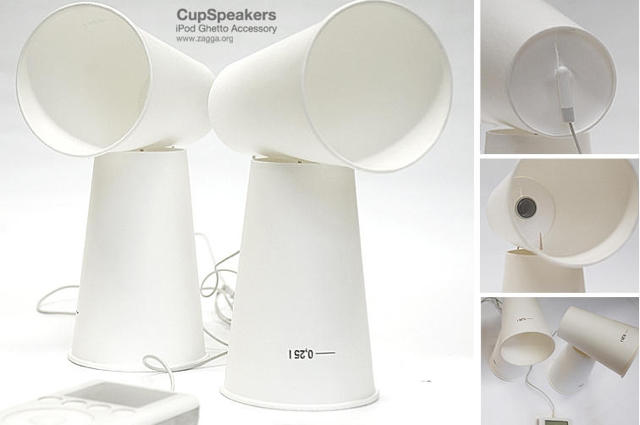
Designer Dmitry Zagga kept his iPod speakers simple: all you need for his CupSpeakers, dubbed the “iPod Ghetto Accesory” are four white paper cups (preferably from the company cafeteria) and a couple of toothpicks to hold them together.
By his own admission, “the increase in volume, of course, is radiculous, (sic?) but hey, you get stylish iPod accessory out of nothing!”
Go figure. Just like Tommy Hilfiger listening to Jimi Hendrix or John McCain listening to Abba, it goes to show there’s a little bit of the unexpected in everyone’s playlist.
The mildly entertaining redemption story of The Rocker hinges on a Mac. Serial-geek actor Rainn Wilson (Dwight Schrute from The Office) plays an almost-been heavy metal drummer called Robert Fishman. His niece, annoyed that she can’t do her homework, uploads a video of his sweaty practice session from her iMac. It goes viral. The rest is history.
The Google Mobile team is expected to enhance its iPhone search product with a voice recognition add-on as soon as today, according to a report in the New York Times.
Having already reorganized the way it delivers the results of an iPhone search request earlier this week, the Mountain View, CA search engine company is taking another step toward perfecting the way it handles the challenges of entering and retrieving information with hand-held wireless devices.
“Solving those two problems in a world-class way is our goal,” says Vic Gundotra, a former Microsoft executive who now heads Google’s mobile businesses.
With teams of voice recognition engineers working in New York, London and Mountain View utilizing trillions of search queries Google users have made over the years, one aspect of the service relies on a statistical model of the way words are frequently strung together, according to Mike Cohen, a speech research who was co-founder of Nuance Communications before coming to Google.
The service also takes advantage of the iPhone’s accelerometer to put itself into “listen” mode when the phone is raised to a user’s ear, a design development contributed by a Google researcher in London.
Both Yahoo and Microsoft already offer voice services for cellphones. The Microsoft Tellme service returns information in specific categories like directions, maps and movies. Yahoo’s oneSearch with Voice is more flexible but does not appear to be as accurate as Google’s offering, according to the Times report.
The Google system is far from perfect, and it can return queries that appear as gibberish. Google executives declined to estimate how often the service gets it right, but they said they believed it was accurate enough to be useful to people who wanted to avoid tapping out their queries on the iPhone’s touch-screen keyboard.
As of this writing the add on was not yet available on the AppStore, but as Raj Reddy, an artificial intelligence researcher at Carnegie Mellon University says, “whatever they introduce now, it will greatly increase in accuracy in three or six months.”
Apple is now Steve Jobs has said he wants to enter by the end of 2008. However, there may be several snags delaying the iPhone getting into the hands of the world’s largest cell phone market.
The new Apple employee would “focus on international releases of our iPhone and iPod touch products for Beijing,” the post reads.
Earlier this year, Jobs told CNBC he thought iPhone launches in China and Russia would “happen later this year.” Although Russia announced in October, an agreement with China has been held up by technologic and political roadblocks.
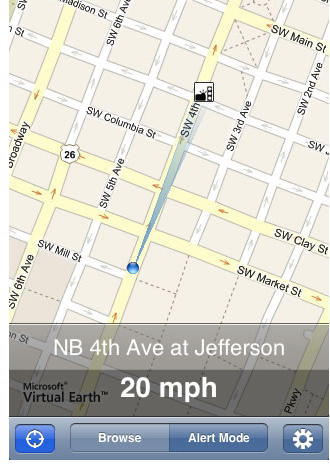
Njection Mobile is a new iPhone app designed to alert you to speed traps, red light cameras, and speed detection devices using the phone’s 3G and GPS capabilities.
The app uses a native Microsoft Virtual Earth Web Services (VEWS) implementation, leveraging the mobile tile set to speed up map displays, and provides what promoters call “one of the best mapping experiences on the iPhone.”
Drivers may be alerted audibly to approaching speed traps based on several different criteria. The application uses an Active Intelligence Selection System to alert users to the most relevant speed trap, based on speed, direction of travel, and current time. Users can submit and verify speed traps directly from the iPhone as well.
The $9.99 application’s features include:
Speech notification of Speed Traps based on current moving direction, speed of the driver, and distance to closest point using Active Intelligence Selection System (AISS)
Live Updates of speed traps updated from the website or other iPhone users
Speed Trap Ranking based on level of enforcement and time of day area is monitored
Submit and Rate Speed traps from the iPhone or on the website
Njection Mobile is compatible with both 3G and Edge network protocols, though the developers caution it may not work as well without GPS.
Citing a “more conservative outlook for the PC industry,” Credit Suisse Thursday cut the target price for Apple shares to $120 from $135. Analyst Bill Shope also trimmed Apple’s 2009 revenue projectionPhoto: Cishore/Flickr to $33.36 billion from $34.85 billion.
In a note to investors, the analyst reversed his projection of PC shipments for next year. Shope believes shipments will fall 4.7 percent rather than increase 4.9 percent.
Overall, PC industry revenue is expected to fall 16.6 percent in 2009, according to the Credit Suisse note.
Shope said his estimate is in line with an outlook for a “severe recession” in the PC market with a 13.7 percent drop in desktop computers compared to a 4.2 percent previously projected.
With consumer buying in the tank and computer makers reportedly readying $299 holiday PCs, can Apple afford to repeat its usual $100 discounts on Macs? One analyst thinks its time for Steve Jobs to get ‘aggressive’ during the all-important ‘Black Friday’ after-Thanksgiving sales.
Barclay Capital’s Ben Reitzes told investors Wednesday Apple should offer discounts on iPhones and iPods, as well as Macs.
“We would like to see Apple get more price aggressive in every product, including the iPhone, given obvious weakness in the economy,” he wrote in a note to investors.
Word comes from Le Macbidouille of Apple’s plans to set up shop in the “Carrousel of Louvre” at the famous gallery complex in Paris.
Slated to begin at the turn of the year, Apple has apparently expanded upon plans originally announced over a year and a half ago, and may become a very high profile tenant at an attraction that drew over 8 million visitors in 2007.
According to the report published at HardMac (conveniently translated into adorable French-English for the non-French-speaking reader), Apple has taken “many options in France, primarily in shopping malls in construction, such as the Odysseum in Montpellier,” and declared “2009 should be the year of Apple Stores in France.”
Here’s a gallery of the space Apple may be converting at the Louvre complex, and sure enough, you can almost see an Apple store in it, can’t you?
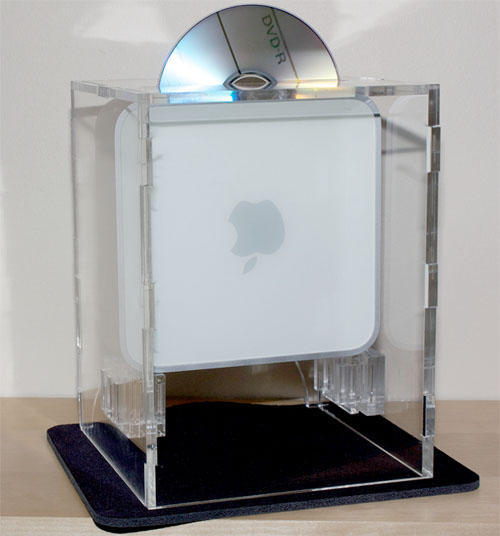
Love this clear stand for the Mac Mini to make it look like a PowerMac G4 Cube. The only slight flaw in handiwork of Trademarklaser is the upside down Apple logo (due to the position of the optical reader) but an etched and painted acrylic cover that would set things straight is on its way. No word on price, but they are for sale.
Flickr user Mickphoto has put up a couple of extensive photosets showing how he hacked an MSI Wind to turn it into an Apple “netbook” he calls the MacBook Nano.
Many have expressed a desire for a small, super-portable Apple notebook and Mickphoto’s creation has a certain je ne sais quoi that’s sure to get the notice of Apple enthusiasts – if not the Apple legal department – and keep the netbook conversation going.
Click on a few shots in the gallery below and visit Mickphoto’s Flickr pages for more. Is this Apple evangelism, a labor of love, or is it over-the-top? Let us know your thoughts about the MacBook Nano in comments.
Apple faces “recessionary headwinds” through 2010, RBC Capital analyst Mike Abramsky told investors Wednesday. Abramsky now predicts 27.8 million iPhones will ship in 2010, down from 31.8 million. The analyst also believed Apple will report $46 billion in 2010, slipping slightly from the $46.6 billion previously expected.
Abramsky, however, still expects Apple will sell 21 million iPhones in 2009 and kept his target price for Apple at $125. Last month, the analyst cut his target price for Apple shares from $140.
What with all the talk about how hard it is to manage large numbers of apps with the iPhones swipey-sidey interface, I wondered what people are doing when it comes to visualizing the things. A computer’s screenshot is one large image (maybe two or three with multiple monitors). You could argue that an iPhone’s screenshot isn’t complete without all its screens – up to 10 of them – lined up side-by-side.
And that’s what some people are doing, in the process creating gorgeous little personalized maps of portable computing. This one by thepatrick on Flickr (used under Creative Commons license – thanks thepatrick), is labeled with descriptive notes that explain each geopolitical region.
If yoo fink Cheezburger haz a flavr, yoo gonna wuv dis iFone app which make da lolcatz go woop-wwop-ffloop in yor pocketz. It down-woads da lolcatz wivvout da web stuffs which crashy yr Safarie. Srsly.
(Alternatively, if you are an intelligent human being who hates lolcats and thinks this post would have been better suited to the Cult of Lolcats blog (coming soon), the Cult apologizes for wasting your time and suggests you move on to the next post. Thank you.)
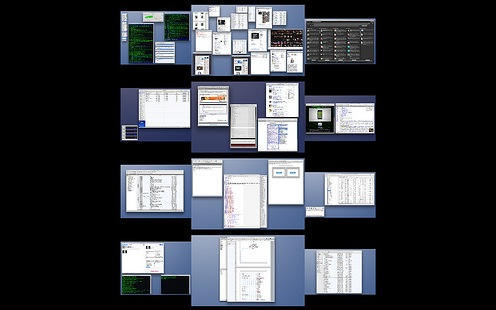
Blake Patterson has the kind of monitor set up that makes some of us drool. It’s even sweeter when three monitors, plus Spaces.app, plus Exposé, produces an image like this; the symmetry and balance turns it into a work of art.
(Photo of Expose+Spaces used under Creative Commons license. Thanks Blake!)
Third party iPhone app developers may be able to update and execute arbitrary code from their applications at will, circumventing Apple’s App Store approval process, according to a report at TechCrunch.
The exploit stems from a trick documented by developer/blogger Partick Collison, who figured out a workaround to allow for the display of dynamic default.png images that load when an app is opened on the phone.
Jason Kincaid, who writes for TechCrunch, believes this security flaw makes it possible that “using the same technique with arbitrary code would likely allow a developer to update and execute whatever code they’d like at will.”
Kincaid notes that this is only an issue insofar as Apple purports to retain control of everything that appears on the AppStore. Developers enjoy the capability of running malicious code in just about every Windows or Mac desktop application you can buy without a screening process similar to the one Apple maintains before allowing iPhone and iPod touch applications to be distributed through the AppStore.
It’s also worth noting that no developer or application has been found to have used this particular exploit to run malicious code to date, and that Apple could act to close the loophole before anyone’s phone is put at risk.
Google’s Android-based G1 cell phone cost $143.89 to build, less than Apple’s iPhone 3G, according to iSuppli Corp.
A teardown of the 8GB iPhone 3G’s discovered the bill of materials for the Apple handset was $172, iSuppi analyst Tina Teng told Cult of Mac.
Nearly 20 percent ($28.49) of the G1 hardware costs are in the ARM processors used for multimedia and modem, iSuppli announced Tuesday. In October, Intel blamed the ARM for speed problems with the iPhone 3G.
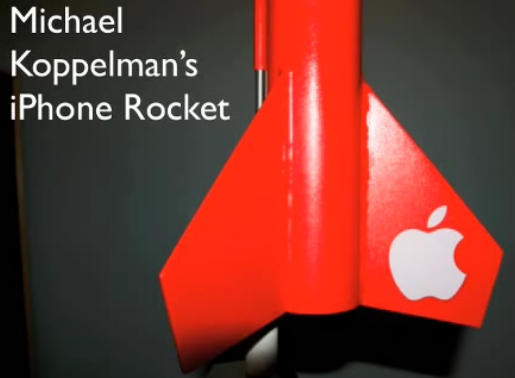
iPhone developer and model rocket enthusiast Michael Koppelman performed a hobby mash-up by launching an iPhone rocket.
He used the packaging the iPhone came in to develop a cradle that fit inside the rocket. The iPhone had its own parachute, just to be on the safe side.
Koppelman developed an iPhone app to monitor the iPhone’s GPS and accelerometers, logging them to a file and sending GPS data over the Web so that the unit could be easily located if it became lost.
The airborne iPhone didn’t break or go missing.
Check out his site for the data or the video of the launch and an interview at Make…
The trailer for Nim’s Island, a Jodie Foster movie about a house-bound adventure writer, starts off with her character Alex Rover dancing a jig in front of a Mac and shows her computer about five more times in the space of a minute or so.
Apparently, the movie is Product Placement a go-go for 12 companies, so much so that at least one pundit complained. The Mac count? Three different computers show up a total of 10 times. Still, if you’re going to be a bogus travel writer, better do it with a Mac.
If you’re the kind of person who loves iChat so much that you want to snuggle up to it on the couch, these pillows from Throwboy are likely to be just your cup of tea.
You can choose from Finder, Dashboard, iTunes, iPhoto, iChat, and Photo Booth. Each one is hand-made with fleece and filled with polyester fiber.
You can nerd up your living room for just $30 per pillow, or $149 for the set. I don’t think they do special requests for niche apps (Camino users, let’s hear a weak cheer from you – ahh that’s lovely). But there’d be no harm in asking them to expand the set would there? What might they add next? Is a BBEdit pillow going too far, do you think?
More on the Throwboy blog. They do pumpkins too, you know.
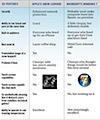
Though we’re still several months away from the launch of either Mac OS X Snow Leopard or Microsoft’s Windows 7, America’s Finest News Source The Onion has already decoded the coming OS war in a handy chart, which you can read after the jump.
I have to say, I’m really impressed that MS is getting close to getting the spontaneous combustion thing under control. Dare to dream!
First made available through the iTunes Store on April 28, 2003, the timeless power ballad “Don’t Stop Believin'” has become the top-selling catalog track in iTunes history and the sole catalog track to have crossed the 2million (double platinum) threshold.
Following its original release in 1981, “Don’t Stop Believin’,” the second single from Journey’s groundbreaking chart-topping “Escape” album, peaked at #8 on Billboard’s Mainstream Rock chart and at #9 on the Pop Singles chart. Propelled by what the All Music Guide has called “one of the
best opening keyboard riffs in rock,” “Don’t Stop Believin'” quickly established itself as one of Journey’s signature songs while helping to spawn the “arena rock” genre.
“Don’t Stop Believin'” hit a grand slam in 2005 when it became the unofficial theme song for the Chicago White Sox, World Series Champions. Journey frontman Steve Perry performed the song at the World Series Championship celebration in Chicago.
The song enjoyed a massive resurgence in popularity in June 2007 after serving as the soundtrack to the climactic final set-piece of HBO’s hit mafia family television series, “The Sopranos.” Download sales
of the song on iTunes rocketed an incredible 482% for the period from Saturday, June 9th (the night before “The Sopranos” finale) through Tuesday, June 12th, of that year, at which time Hillary Clinton also chose it as her presidential campaign theme song.