Blogger Charles Teague has done some comprehensive analysis of emerging trends based on the AppStore’s first 5 months of business and there’s no denying Apple’s online distribution model has exploded out of the gate.
I wrote a couple of weeks ago about the proposition that the AppStore could be Apple’s most revolutionary development of all, which Teague’s research would appear to confirm in many respects.
The chart below shows the number of applications being released per day, with momentum clearly trending upward and sitting currently at more than 140 new apps per day. There are more than 9000 apps available on the AppStore, with the ratio of paid to free apps at about 7:2.
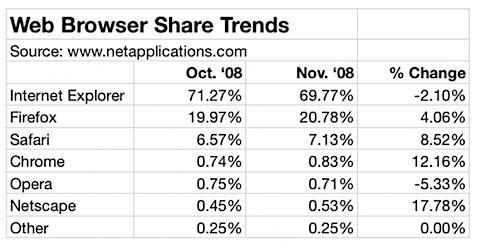
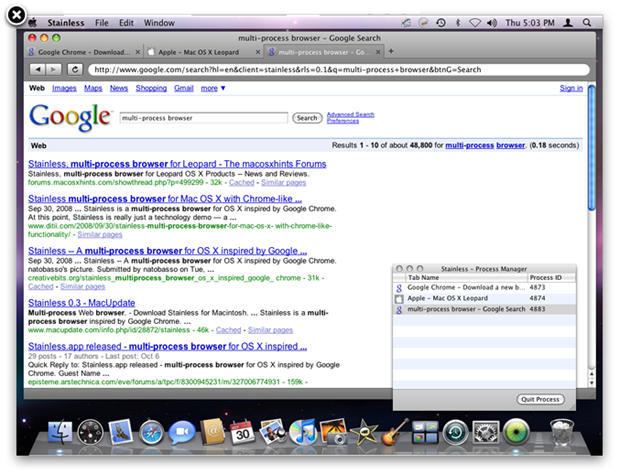
Stainless is a multi-purpose browser for OS X inspired (according to its developers) by Google Chrome. The early beta version (0.4) available for download works only with 10.5 (Leopard) and appears to be a fun side project for the engineers at Mesa Dynamics, who developed Stainless to leverage multi-processing technologies they developed for one of their other products, Hypercube.
Blogger Jackson Chung has taken Stainless for a spin and writes that it has potential. “It is a fair bit more stable, quicker and simpler to use [than other Mac browsers] – and that appeals to most people who are stuck with the productivity-driven mindset of Do more with less time.” He applauds Stainless’ simple UI and the fact that every browser tab runs under a separate process.
Unlike Safari, for instance, which runs tabs under a collective process, Stainless ‘feels’ lighter, according to Chung, and the whole surfing experience seems quicker and more responsive.
Google is working on a Mac version of Chrome and Media Dynamics gives the impression that Stainless may well be no more than a demonstration of the possibilities we could see when Chrome for the Mac is finally released. Until then, however, Stainless looks to be a taste of things to come.
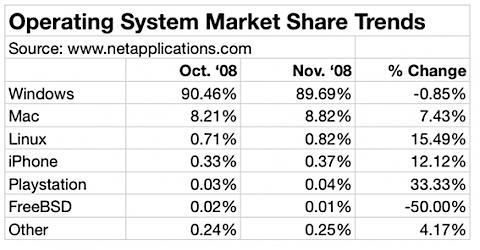
The iPhone DevTeam took another brick out of Apple’s walled garden on Friday, successfully booting the Linux operating system on the iPhone, iPhone 3g and the original iPod Touch, according to a report at AppleInsider.
The “draft version” of the first alternative OS to run on Apple’s mobile devices includes the main Linux 2.6 kernel as well as “rudimentary graphics, serial, and other functional drivers that are enough to get a command line running when input is sent over the USB interface; the accelerometer, audio, networking and even the touchscreen have yet to receive any kind of software support,” according to the report.
Having led the way from the very beginning with efforts to jailbreak and unlock the iPhone, the Dev Team is working to enable Google’s equally Linux-based but more complete Android mobile operating system on the iPhone and is searching for programmers to help with the project.
iPhone has a handy TV-Out functionality that lets you watch stored video on a TV monitor connected to the iPhone, and as demonstrated in the video above, can even push live camera input through the updated MediaPlayer framework included in version 2.2 of the iPhone SDK.
Developer/blogger Erica Sadun enlisted members of her family to assist in documenting this cool development over the Thanksgiving holiday, and credits fellow developers Drunkenbass and Greg “go2” Hartstein with helping her integrate user input through iPhone’s on-screen controls.
As Sadun mentions in her post at Ars Technica, this feature may useful in making the iPhone an active participant in the development of new video/phone hybrid apps and as a vehicle for delivering Keynote/PowerPoint-style presentations.
With iPhone, it just keeps getting better and better.
The first Apple reseller is as good a reason as any to fly through Montreal’s Pierre Elliot Trudeau airport.
The recently-launched Boutique iStore, a petite 225 square feet, offers free Wi-Fi, an iPod bar as well as a few useful accessories, like the power cord you left in the office in a hurry to dash.
It’s the sister store to an Apple retailer in central Montreal, which gives some assurance that the operation isn’t fly-by-night — and that if you need to service on something you bought at the airport, you don’t have to trek back out there.
ifoAppleStore, a site dedicated to keeping an eye on Apple stores, said that Apple retail execs once mentioned the mini-store prototype might move into airports, but the concept was never expanded beyond the original nine stores.
With long layovers the norm, this is an idea whose time has come.
Yurii loves his MacBook Air so much, he made an advertisement for it. I like the moment at 1:33, when he compares the thickness of an old Acer machine with the thinness of an Air.
Have you made any Apple product advertisements recently?
Come to think of it, have you made any advertisements for products you like recently? Even Acers? Just wondered.
Apple’s latest lstandalone Cinema Displays, the 24″ widescreen with LED backlight technology announced in August, have shipped and began arriving Wednesday for customers also fortunate enough to own Apple machines with mini-Display port connectors.
The new 21lb bright, shiny things work only with the new MacBook and MacBook Pro notebooks and the Macbook Air, a limitation puzzled over by many in the wake of the August announcement, but now that they are here, object lust would seem to be kicking in predictably for many.
Ars Technica blogger Clint Ecker did an unboxing first impressions post on Wednesday, a few shots from which can be seen in the gallery below. Of note is the high-gloss reflectivity of the display glass and the fact that Mac OS X elegantly defers to the display’s iSight instead of the notebook’s. It also uses the USB audio on the display, disabling the output on the notebook until you plug into the notebook’s headphone jack. Ecker says the Cinema Display appears “slightly brighter” than the display on a similarly sized iMac.
The winner – as judged by me at midnight GMT tomorrow (November 27th, which is also my birthday, yay) – will be sent a unique, once-in-a-lifetime PDF containing the word “Woof” in 27 different fonts.
Never say that Cult of Mac doesn’t offer you the most amazing prizes.
(Photo used under Creative Commons license, thanks to Arroz con Nori on Flickr).
For MacAddict and MacUser editor Rik Myslewski has penned the second in a series of essays about Apple’s place in the world for The Register. This one looks at the company’s environmental and philanthropic activity.
Myslewski says that in both areas, Apple has only very recently showed signs of the kind of corporate responsibility commonly displayed publicly by its rivals and peers in the business.
The new green MacBooks only appeared after pressure by Greenpeace, which included public humiliation of the company in the charity’s 2006 Guide to Greener Electronics, where Apple was placed fourth from bottom. There are no records of charitable giving until the recent, sudden support for the Anti Proposition 8 movement in California.
If Apple has been giving more to charity, says Myslewski, it has been doing so under the utmost secrecy. Which leads him to believe that no such giving has taken place at all.
Which, Myslewski declares, is “shameful” for a company with so much cash in the bank. He gives the company an “F” rating for this particular part of the report card he’s writing.
What do you make of it all? Is Apple being treated harshly here, or is Myslewski making a good point?
With the economy exuding the stench of death and government busy creating trillions of dollars worth of fictional capital to “bail out” some of the nation’s brand-name institutions, Low End Mac believes their philosophy of “use it up, wear it out, and then recycle it” could not be more timely.
“We are the kings of making our computers last, last, and last some more,” writes blogger John Hatchett in a great piece describing how he turned his old iMac into a digital jukebox. With a little bit of drive cloning and hooking the iMac up to his home stereo, he now listens to his iTunes library all over his house.
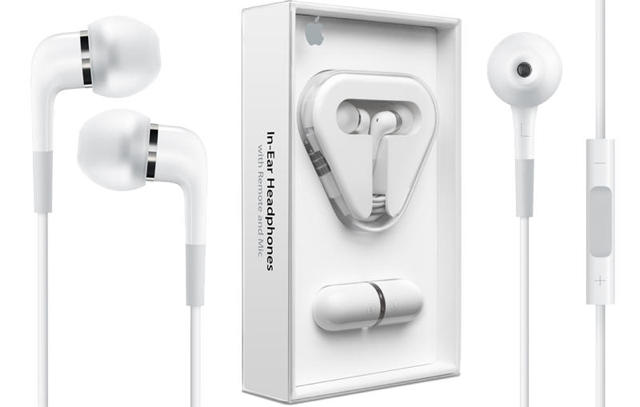
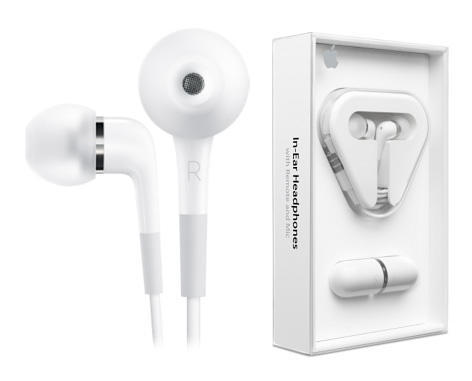
iFrogz, developer of accessories for iPod and iPhone announced the availability of its first line of customizable earphones Tuesday, claiming to offer over 200,000 unique possibilities among three new products.
I could think of any number of words to describe what may be going on in the marketing department at the company’s Logan, UT headquarters, but they can certainly be said to think different.
For starters, the product line is called EarPollution, with individual offerings named Hype, Fallout and Nerve Pipes. The whole campaign calls to mind some kind of industrial accident rather than a new wave of must-have items in the over-saturated earphone market. Then again, standing out from the crowd is a definite strategy.
And stand out the iFrogz headsets do, too. From the ultra-bling options available on the Nerve Pipes to the slightly more downbeat style of Fallout (both over-ear) and the low-profile, in-ear Hype, users can customize color and artwork for headbands, speakers, earpds, even hinges (on Nerve Pipes), giving them what iFrogz CEO Scott Huskinson calls “complete creative control to develop something truly unique and original.”
Styles retail from $19.99 for the Hype earbuds, and $34.99 for both the Fallout and Nerve Pipes. Despite the estimated 235,000 unique combinations currently available the company promises more customizable options will become available at a later date.
Ahead of what is likely the most nervously anticipated Holiday Season for retailers in more than a generation, Apple joined the Black Friday bandwagon Tuesday, announcing a “one-day-only holiday shopping event” for the day after Thanksgiving.
Subscribers to Apple’s Inside Apple News received an email Tuesday announcing the company’s “biggest shopping event of the year” and visitors to the Apple online store found promises of “dozens of great iPod, iPhone and Mac gift ideas” good for Friday only. No word yet on what Friday’s pricing is going to look like or what items in the catalog will be on sale.
Now that Apple holds such a prominent place in the retail trade the company should be expected to follow many of the industry’s marketing rituals, but it’s probably a safe bet they are a little less nervous in Cupertino than in, say, Minneapolis (home of Best Buy) or Bentonville, Ark. (world headquarters of Wal-Mart).
Apple could release an $800 netbook in 2009, Piper Jaffray’s Gene Munster told investors Tuesday. Munster is just the latest advising the Cupertino, Calif. computer maker to offer an inexpensive laptop.
Although CEO Steve Jobs has poo-poohed talk of a netbook, dismissing the growing trend as just a “nascent market,” Munster believes Apple has the perfect platform: the MacBook Air.
In a note to clients, the Apple watcher said Apple could release an 11-inch version of its MacBook Air notebook and sell the unit for between $800 to $1,000.
For Beatles fans looking to download the iconic British rockers from Apple’s iTunes, it appears its going to be another ‘Hard Days Night.’ Paul McCartney now says negotiations are at a stand-still.
“The last word I got back was it’s stalled at the whole moment, the whole process,” the musician told the Associated Press.
The sticking point, according to McCartney is EMI, which owns the Beatles song catalog, and Apple Corps, a holding company run by surviving members of the UK band.
Apple shares climbed 12.5 percent Monday to close at $92.77 amid bullish analysts who saw demand for MacBooks breaking from the trend to lower expectations.
Despite reducing expectations on iPhone and Mac desktops sales for 2009, several Apple analysts told clients they expected sales of new MacBooks to increase.
On Monday, Oppenheimer’s Yar Reiner raised his projection for MacBook demand to 1.61 million, up from 1.54 million. Reiner pointed to the new unibody construction for his increased enthusiasm.
Green is the new black. And once again Apple is in the forefront, for better or worse, of a coming trend. It’s hard to imagine any technology company having the stones to advertise its products as good for the environment, which, to be fair, Apple doesn’t say here.
But the ad does tout the new notebook line’s aluminum enclosures and glass screens as 100% recyclable, points out that their power consumption is less than that of a light bulb and says they are mercury free. All steps in the right direction, to be sure.
Here’s a gallery of a dozen very cool Apple/Mac wallpapers you can use to liven up your desktop or simply go for a change of scenery. These were sent in by reader Henrik Andersson, who blogs for We Find the Stuff and found these at deviantArt, where there’s even more to be found.
You don’t need to be in holiday stress mode to realize the zen benefits of playing with Koi Pond on your iPhone or iPod Touch. Tis the Season, however, and the dev team at The Blimp Pilots studio have added a holiday theme for your added enjoyment of one of the best apps I’ve seen to leverage the awesomeness that is Apple’s touch interface and accelerometer.
Koi Pond is an application with a graphically realistic pond filled with Koi fish. You can move your finger around the screen to create ripples in the water that send the fish scurrying for safety off the screen. You can rearrange the lily pads, feed the fish, even get them to come and nibble your finger by leaving it in the water. The app has beautiful 3D sound, too and rates, for my money, among the best bucks I’ve ever spent.
On the Apple Store website, it seems clear your choices among the iPod Touch offerings are 8GB, 16GB and 32GB models. Alerted by a photo posted by Flickr user iTomath, however, I was drawn to the What’s New with iTouch info page on the Apple site and, sure enough, the photo on the page as of this writing appears to indicate a 33GB device. Not that 1GB makes any difference in this day and age, but it does seem odd, doesn’t it?
A few weeks back, we featured a post on design student Kyle Buckner’s wooden iPhone pedestal. Kyle contacted us today with news and info on his latest Apple-inspired creation, a custom timepiece commissioned by the Apple Store in Richmond, VA for one of their special customers.
Buckner built the clock over the weekend, using hand-cut and polished plexi-glass. “I went out and bought a clock , and stole the motor out of it,” he told Cult of Mac, adding “then I searched on the internet and found a free background that referred to Apple, edited a few things in Photoshop and printed them out to attach underneath each piece.”
Check out the gallery below and follow after the jump for more on Buckner’s background and plans for the future in Apple-inspired design.
The developers behind Boxee, the social media center that distributes video content between your computer and TV, announced Monday a fix for Apple’s recent update of AppleTV.
The fix, outlined on Boxee forums, replaces a manual hack to get the application working after disabled by Apple TV 2.3, which Apple released last week.
In a blog post, the Boxee team provided instructions on how to update the USB Creator application. So far, around 35,000 people have downloaded the fix.
Boxee, which includes CBS, Netflix and Hulu among partners, recently received $4 million in venture funding.
Last week, Apple released update 2.3 for its AppleTV devices. Among the new features introduced: AirTunes streaming and wider iTunes support.
Taskpaper is the simplest sort of task management environment you can think of, and that’s why it’s so useful. It doesn’t try to do everything. But it does one thing – manage lists – extremely well indeed.
The new release has lots of new features, such as a new search system, custom themes (so you can have green-on-black Terminal style lists if you like), and (my favorite new addition) a system-wide keyboard shortcut that calls up a Quick Entry Window for, erm, quickly adding entries.
I’ve seen people criticize Taskpaper because of the features it lacks, but I don’t see it that way. It omits many things that appear in other task management apps, and it does to with purpose. Taskpaper keeps things simple. If you want to put more focus on getting things done than you do on Getting Things Done, Taskpaper is the app for you.