The iTunes App Store saw a mass overhaul over the weekend in a move to more vibrantly showcase apps on their individual pages while simultaneously presenting more relevant information to potential buyers.
iTunes App Store pages get overhauled
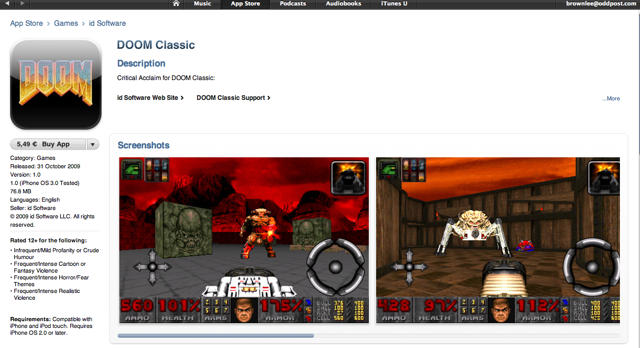
The iTunes App Store saw a mass overhaul over the weekend in a move to more vibrantly showcase apps on their individual pages while simultaneously presenting more relevant information to potential buyers.
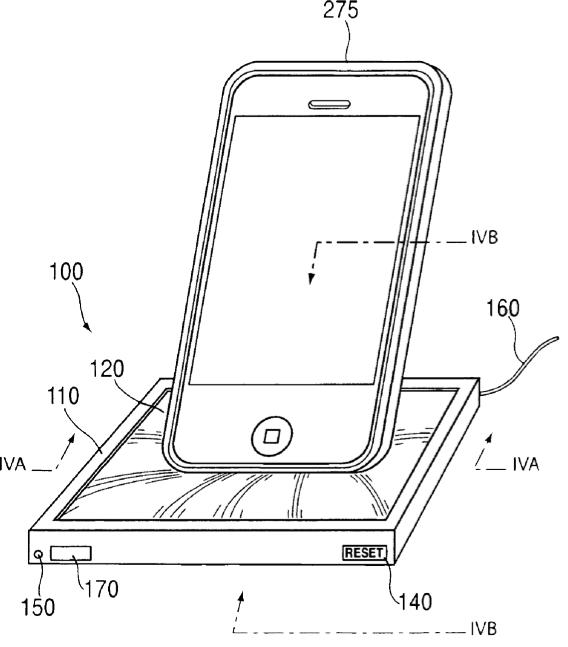
Ah yes! Another Apple patent to swoon over! What mad genius will we glimpse in the minds of Cupertino’s engineers through the soothsaying of this sheath of dry legalese and blusterless line drawings? An Apple Tablet that also sports the incredible dual-function of the radioactive lumen output of a tanning lamp? The iPoiuyt: a brand new Shuffle in the impossible shape of a blivet? Some sultrily seamless and unibody sex bot?
If only. Instead, the latest Apple patent, published on Thursday but filed in June 2008, describes a new universal dock for the iPhone and iPod. The idea is to get rid of all of those cheap plastic iPod dock adapters and instead use an elastic, form-fitting substance which moulds itself around each of the iPod line’s unique shapes.
It’s not a bad solution, but I wouldn’t exactly expect this patent to ever become a retail product. Squishy elastic rubber doesn’t exactly seem like a good fit for Apple. I would imagine that future iPods and iPhones will adopt a charging and docking system similar to the Palm Pre’s galvanized lozenge, the Touchstone Charger, as soon as wireless USB makes a little more headway.

UK newspaper The Guardian this morning launched its iPhone app.
And wow, it’s pretty damn good.

The App Store remains a bone of contention for many developers, but IUGO knew its A.D.D. game would throw multiple spanners in the works. That said, it wasn’t expecting its minigame collection with a decidedly risque bent would languish in the approvals process for months. At the end of November, it finally emerged, having been stripped of many games, but still boasting 70 quickfire challenges for iPhone gamers.
I spoke to IUGO Director of Business Development Sarah Thomson to find out about how A.D.D. came to be, and about IUGO’s struggles to get the game approved for the App Store.
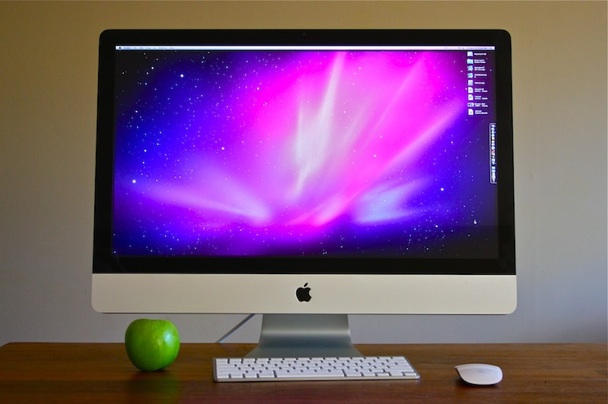
After our recent post about Apple computers held hostage as they were sent to the FDA with documentation as if they were fruit, Susan Rosenberg, a public relations manager at UPS, cleared up the mystery in an email statement to Cult of Mac:
“Apple products are not being associated with fruit for import documentation or clearance. It’s coincidental that UPS groups the FDA and Dept. of Agriculture in the same tracking message as UPS provides detailed real-time visibility of events through our process.
The FDA does have import documentation requirements for low-level radiation-emitting devices with lasers such as CD-Roms or DVD components that are part of most any computer.”
Rosenberg points us to the Food and Drug Administration page about Radiation Emitting Products, where one is reminded that sending electronic products — including those cell phones, ultrasound diathermy devices or microwave blood warmers you were going to pop in the post — will be inspected. (Kudos to CoM readers who commented on the previous post that this was the real cause).
So, what are the delays about, then?
Is Apple taking a more lenient approach to approving App Store developers? After being beaten about the head and shoulders for it penchant to toss violators, the Cupertino, Calif. has approved a number of applications that used private software references. In the latest case, Apple approved iSimulate with only a warning.
“While your application has not been rejected, it would be appropriate to resolve this issue in your next update,” Apple e-mailed developer Vimov. The problem: iSumulate uses a private API to gain access to the iPhone’s multi-touch and accelerometer features.

Apple Friday sued Nokia, claiming the Finnish cell phone giant infringed 13 patents. The countersuit follows an October lawsuit by Nokia which alleged the Cupertino, Calif. iPhone maker had infringed 10 patents.
“Other companies must compete with us by inventing their own technologies, not just by stealing ours,” said Bruce Sewell, Apple’s General Counsel and senior vice president in a statement.
Lala, the streaming-music startup Apple recently purchased for a reported $85 million, was just the latest chess piece in a competition between Cupertino and the Internet giant Google. The Mountain View, Calif. company was in “serious discussions” to purchase La La Media prior to Apple’s recent acquisition, according to The Wall Street Journal. The newspaper Friday cited insiders with knowledge of the issue.
Although Apple was the victor in that case, Google had earlier paid $750 million for AdMob Inc., a mobile advertising firm that the Cupertino, Calif. based iPod-maker was also pursuing. The two cases reflect a heated competition between the two companies which are butting heads on a number of fronts. In the case of La La, Google wanted a greater piece of the online music pie (an area in which Apple is already well-entrenched) and Cupertino eyed AdMob as a path to greater involvement in advertising, a lucrative area for Google.
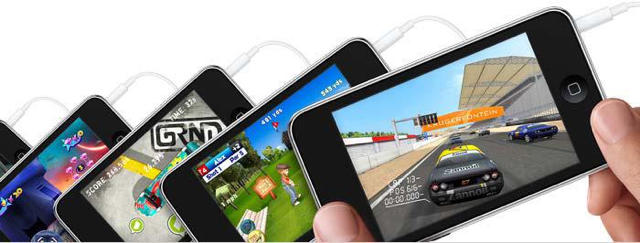
Despite the fact that the iPod Touch is increasingly being branded as a gamer’s device, Apple’s never had much truck with gaming… at least in-house. But new calls for a video game artist for the iPhone Gaming Group imply that Apple might be preparing to make a serious push into the gaming market, perhaps to better compete with other handhelds like the Nintendo DS.
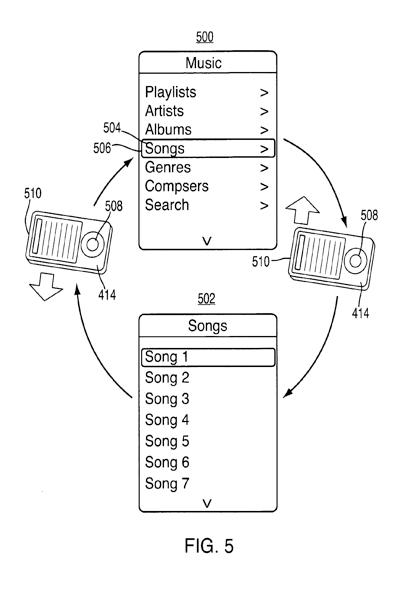
Apple’s patents only rarely give us the first look at new products in Cupertino’s pipeline, but they can still be wholesome brain fodder to chew over, as they at least give us a glimpse at the current problems the company is trying to solve. Let’s mull over, then, Apple’s two latest patents, each as different from each other as it can be.
The first patent Apple has applied for is a “technology” that would allow their Geniuses to know when a device has been “compromised” by being opened. It’s not much of a technology: it’s just a little sticker affixed between an electronics component and the chassis’ removable lid. Think of it like Apple’s own iteration of that venerable classic of anatomic technology, the hymen: Open your laptop or iPhone and the sticker will tear in half, thus letting any future delvers know that your device has been sullied.
Clearly, the aim here is to give Apple an excuse to void warranties on modified machines, which is understandable if not entirely welcome.
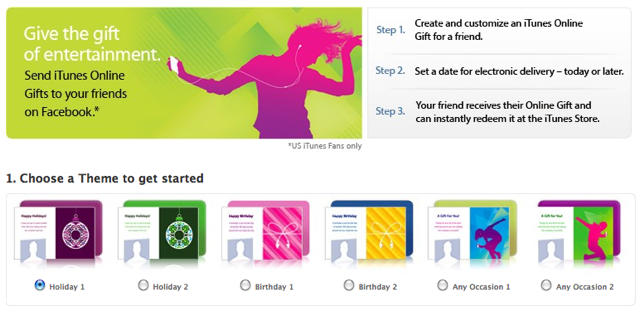
If, like me, your Christmas shopping list has question marks next to two petulant twin nieces whose only interests seem to be quoting popular song lyrics and passages from Twilight on their Facebook pages with infinite, poorly spelled gravity (and who then quickly delete the helpful replies you leave criticizing them for being such idiots without even making a passive effort to absorb the stately, elder wisdom of your words)… well, why not consider buying them an iTunes gift card through Facebook?
Yes, the popular social networking site has just introduced an application that lets you buy iTunes gift cards for other users. The cards come in $5, $10, $15, $25 and $50 denominations, and the interface even allows you to select a date when the gift card should be delivered. The cards come in six designs: two holiday cards, two birthday cards, and two generic cards featuring those psychotropic iPod silhouettes at a rave.
For me, this is actually ideal. My nieces are fifteen years old, and I’ve long since given up on trying to suffer through a sulky, eye-rolling conversation with either of them long enough to try to ascertain their interests. Buying them an iTunes card through Facebook is exactly the sort of impersonal yet convenient gift that I’ve been looking for: it certainly beats this Edward Cullen laptop decal I was planning on getting for them.
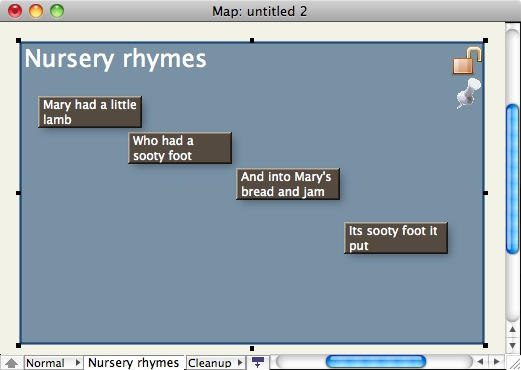
Eastgate Systems has just announced Tinderbox 5, a major update to its venerable note-taking application.
“Note-taking” hardly covers it, though. Tinderbox is uniquely flexible and adaptable, in a league of its own when compared with all the other OS X notebooks.
Although it’s certainly an iconic advertising slogan, I’ve always felt Apple was wise to leave “Think Different” behind as a manta for their Macs.
Poor grammar aside, the slogan is more suited to a small, sprightly underdog weakly jabbing away at a juggernaut, which Apple certainly was back in 1997, but is much less so today. As a slogan, it also has too much of the tell-tale whiff of smugness about it, a problem Apple’s advertising has wrestled with for most of the last decade. “Get a Mac” is better: it’s strong, it’s simple and it is assertive, not self-satisfied.
Still, maybe the old slogan could work in a new context: Apple has applied for a new trademark for “Think Different”…. and it may imply that the vintage slogan will be used to advertise the forthcoming Apple Tablet.


Perhaps with the jeers from selling just 5,000 iPhones during the first days following its launch still echoing in their ears, China Unicom Thursday announced it has sold over 100,000 of Apple’s iconic handsets since Oct. 30. Despite the seeming uptake in interest, experts remain skeptical.
“iPhone sales have been disappointing,” Samsung Securities analyst Paul Wuh told The Wall Street Journal. Selling just 100,000 iPhones with 144 million subscribers won’t help China Unicom’s bottom line, according to the analyst. China Unicom also faces the prospect of competing with its larger rival China Mobile for Apple’s attentions.
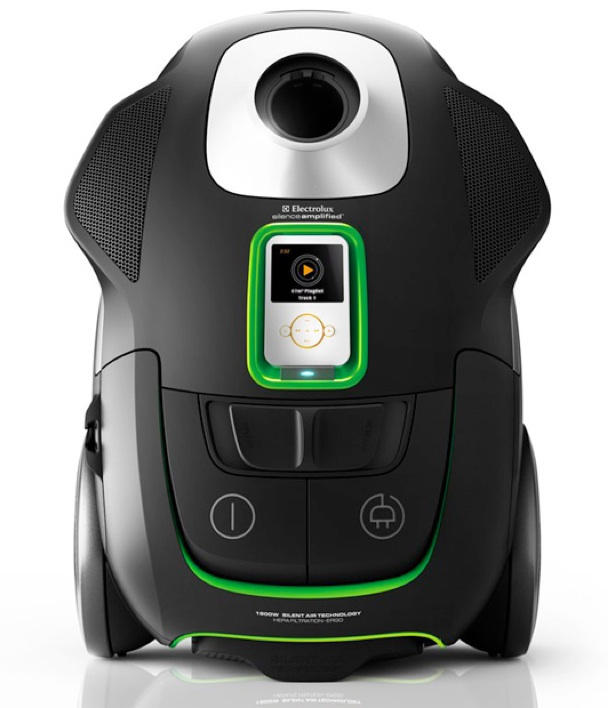
Vacuuming is one of those mundane chores that can’t be helped much by listening to your iPod.
The beast whirs and whines over whatever soundtrack you try to stuff into your ears while hoovering over stale cornflakes.
Recognizing this immense problem, Electrolux invented a concept vacuum called the UltraSilencer. It’s so quiet, that you can dock your iPod on the front and built-in speakers on the sides blast your fave whistle-while-you-work tunes. (Perhaps to avoid a lawyer king-of-the-hill match they’ve put some iPod-like MP3 player in the mock-up).
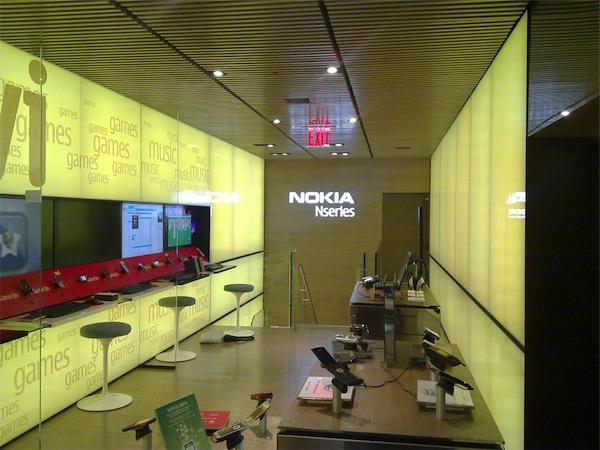
Just days after turning out the lights on its London flagship store, cell phone giant Nokia has shuttered its New York and Chicago stores. The move is described as a “realignment” of marketing and only the latest indication Apple’s retail success isn’t easily replicated.
Nokia discovered consumers used its shops for browsing, but went elsewhere to make purchases. “They would use the stores to test out devices and then go home and buy the device they wanted online through Amazon, Newegg, Dell or even the Nokia USA store,” according to Nokia Experts.
Both stores opened in 2006 with a goal to “educate consumers on the Nokia brand.”
The latest shut-downs follow Nokia’s Regent Street closure in London earlier this week. The store closings are only the most recent sign the iPhone is making greater inroads on Nokia’s territory. Apple shipped 7.04 million iPhones during the September quarter, making it the third-largest smartphone maker behind Nokia and RIM, analysts announced in November. Another blow to Nokia was the news Apple had passed the Finnish giant in profitability.
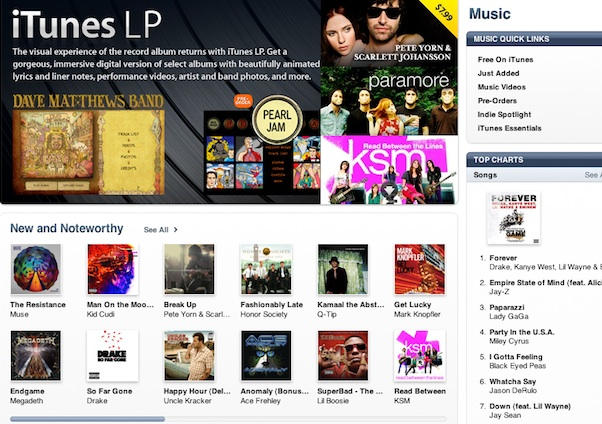
Apple is exploring moving iTunes to the Web, the latest ripple from the Cupertino, Calif. firm’s purchase of streaming music service Lala, a report said Thursday. The switch, which could come as soon as 2010, would let music fans listen to tunes from a Web browser rather than stored on a personal computer.
The new reports could buttress those suggesting Lala’s aquisition may be part of Apple embracing “cloud computing.” Apple has also made tentative steps toward a Web-based iTunes with its Preview service. iTunes Preview removes the requirement that people have the iTunes software installed in order to preview material.
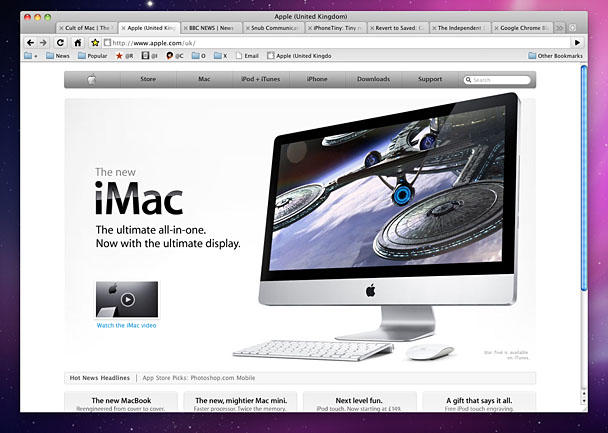
Google Chrome for Mac arrived yesterday in beta form. The browser is lacking important features, including bookmarks and cookie management, and the useful app mode available in the Windows version. Also, benchmarks show it’s marginally slower than Safari. But in use I’ve found it good enough to set as my default, and Chrome’s superior to Apple’s browser in important ways: it launches more quickly, and is far less taxing on my Mac regarding RAM and processor usage, even with many tabs open.
However, one thing I’m finding irritating is Chrome’s tabs. Google’s efforts elsewhere in making Chrome a Mac-like experience should be applauded—the browser supports Keychain and the Mac OS X dictionary, and there are subtle animations peppered about—but the main toolbar and tabs area is problematic. I spent a short while making a mock-up (see the full-size version on my Flickr page), which offers ideas for a more Mac-like Chrome interface.

UK supermarket giant Tesco has just announced tariffs for iPhone, which will go on sale from the company next Monday (December 14th).
The headline they’ll be using in adverts is that this iPhone is available for as little as £20 per month. Whether you go for a contract or decide to pay-as-you-go, this gets you £60 worth of calls and SMS messages (assuming PAYG customers top up at least £20 per month, which qualifies them for extras – and obviously encourages them to switch to a contract). Also consider that the free credit is applied once a month and only lasts for one month, then automatically expires.

We begged. We pleaded. We begged some more. Steve Jobs finally listened — this morning, Ustream made live streaming from the iPhone a reality (pinch me!) with their Broadcasting app.
Yes, the clouds are finally parting. In the last week or so, there’s been a flurry of activity on the streaming-iPhone front: On November 30th, Fring — a VOIP app that allows users to stream one-way video to another iPhone with Fring installed (turning the iPhone into a one-way videophone) — went live at the App Store. One day later, Knocking Live Video allowed two-way video-iPhone-ing.
Now, Ustream Live Broadcaster lets the iPhone broadcast to a mass audience via the Ustream website — and it’s pretty damn cool. And free. It even works over a 3G connection (albeit a bit wonkily — a friend of mine likened it to a NASA broadcast from the shuttle). And because the iPhone’s camera is on the gadget’s backside, using the little guy to stream to a wide audience makes much more sense than does two-way videophoning with it.
So have the floodgates finally opened? And will the next iPhone, rumored to be in the works, bring major advancements in video conferencing (for instance, a camera that isn’t on its butt)?
[ via TechCrunch ]

Whatever reality-bending substances are being imbibed, chewed or smoked at UPS, sign me up: they tagged Adam Jackson’s iMac Core i7 as a fruit.
And now his work tool is awaiting inspection by the FDA, after UPS did the smart thing by “submitting proper documentation” for what it believed was a 40-pound shipment of possibly forbidden fruit from China.

Sounds like a funny fluke, but there’s more than one burnt bulb at UPS processing centers — MG Siegler at Techcrunch had the same problem just last week.
Note to UPS: the words “apple” “mac” and “core” do NOT necessarily mean foodstuffs.
Or are they just PC people messing with us?
UPDATE: After viewing your comments about other incidents, we asked for a comment. Here’s what UPS had to say about it.

When I was a kid, I always thought those photostrip booths dumped unceremoniously near the entrance of suburban malls were like a mini fun house and a comic-strip press rolled into one.
Now, with a service they’re calling Wink, Shutterfly brings those booths to your iPhone ( the comic-strip press part, anyway — but I’m assuming instructions for making a booth out of cardboard and gum can be found at Craft:)
Just download the free app, shoot away and upload anywhere from three to five photos; Shutterfly does the rest, combining the photos into a strip and shipping the product off to any Earthly address desired — all for $2.50, which includes shipping and tax (and Shutterfly says the photos can be uploaded from anywhere in the world). No iPhone (really?), no problem — photos can be uploaded from Facebook and Flickr too.
Bonus: Shutterfly says it’s giving away three (count ’em!) free strips to the first 50,000 strip-crazed iPhone users who download the app.
Me first. Just as soon as I head over to Craft: to figure out how many packs of Bubblicious I need to chew for booth material.

Apple is preparing to release a limited beta version of Mac OS X 10.6.3, following just a month after publicly introducing 10.6.2, according to a report.
The update — expected within 48 hours — will include an unknown list of issues and carry a “10Dxx” prefix, the report claims. (When 10.6.2 was detected, it carried a “10B” and “10C” prefix.) The previous update addressed a series of issues, including the notorious “guest account” bug that deleted data when logging into or out of a Mac running the Snow Leopard operating system.
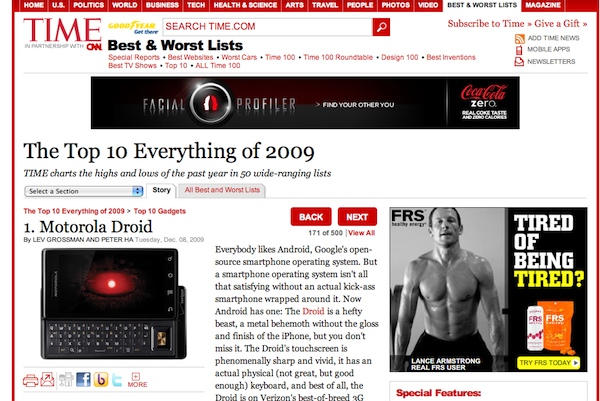
Motorola’s Droid, Verizon’s answer to the iPhone, was ranked the No. 1 gadget of 2009 by Time Magazine Wednesday. Apple’s iconic cell phone finished in fourth place, behind Barnes & Noble’s Nook e-reader and Dyson’s $300 Air Multiplier fan. Is the Droid winning the buzz war for the hippest handset?
“The Droid is a hefty beast, a metal behemoth without the gloss and finish of the iPhone, but you don’t miss it,” according to the magazine. The entry is praised for its “phenomenally sharp and vivid” touchscreen and its connection to AT&T rival Verizon Wireless. “Best of all, the Droid is on Verizon’s best-of-breed 3G network. It’s Android’s first credible challenge to the iPhone,” said the writers.
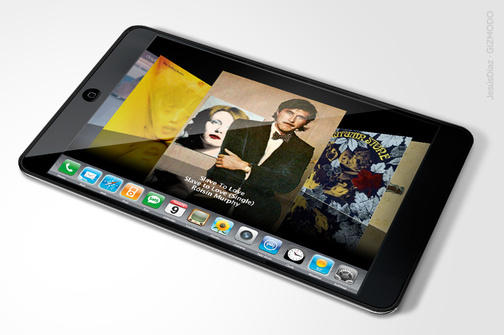
Apple’s long-rumored and much-discussed tablet will appear in March or April 2010 with a 10.1-inch screen and a $1,000 price tag, according to an analyst. In what has become a cottage industry, Oppenheimer’s Yair Reiner told investors production will begin in February.
“The manufacturing cogs for the tablet are creaking into action and should begin to hit a mass market stride in February,” noted Yair, citing “supply chain” checks. Such a timetable would put a product launch in March or April.