To date, Dragon’s Lair — that “classic” quarter sucker of inexplicable and catastrophic player death animated by Don Bluth and first released to arcades in 1983 — is available for over 59 different platforms. Now you can make it sixty: Dragon’s Lair has officially been released for the iPhone.
With Time Capsules epidemically failing after an average of 18 months and 22 days, it might be time to start thinking about an alternative use for your pristinely albino, Apple-branded router once its body squirts out its last breath of 802.11-n ectoplasm.
Why not turn it into a lovely gift box? Over at Instructables, there’s a handy little tutorial on how to convert a Time Capsule into an ornamental box worthy of display, simply by prying it open, gutting it, then adding hinges and a silk cushion.
Not the most revolutionary use for an old Time Capsule’s casing, certainly, but this would be great presentation for, say, an iPod Touch gifted to a loved one later this month, and it can even be reused as a jewelry box or even a humidor (for cigars or the disembodied fingers of people who owed you money, you decide).
Cyclists ride down San Francisco's Folsom Street during one of the city's legendary Critical Mass rides.
First Boston launched its CitizensConnect app in June, giving its citizens the ability use the iPhone to tag locations and upload photos of potholes and other urban hazards; now San Francisco is using the iPhone to build a better city too — through tracking cyclists with its CycleTracks app.
Dragon Dictation is a cool, free little app that allows you to write emails or text messages just by talking into your iPhone, because it transmogrifies your speech into text. In fact, I’m using it to write this.
Well, sorta. As documented by the above-left screenshot, even with the most pristine elocution I could muster, the results provided by Dragon Dictation still left me with errors to clean up. The above-right shot is what happened when I spoke with my everyday, habitually clipped delivery.
So, perhaps not the best solution for popping out a quick text on the road, but a good option to quickly get text down in words that you can straighten out later. Because Dragon Dictation is service-based, connection via wifi or 3G (i wasn’t able to test it using EDGE) is required. And right now Dragon Dictation is free, making it easy to take out for a test spin.
PC users (yes, PC users read Cult of Mac) might correctly identify Dragon as the same engine that powers Dragon NaturallySpeaking, the impressive speech-to-text PC app (and MacSpeech Dictate, a similar app for the rest of us).
Released over a year ago for the PC, Google’s wonderful Chrome browser has been purgatorial on the Mac for far too long, but now that’s all over: Google has finally released Chrome in beta form for OS X.
Mac users have a duty to download the beta and help Google finish it — it’s a great piece of work.
It’s a feature light release compared to the PC and Linux versions. For one, the Mac version is missing its Bookmark Manager and Bookmark Syncing; it also omits the App Mode, which allows Chrome to run web apps in their own basic browser window. Google’s Gears is also off the table for Mac users, but Gears won’t work under Snow Leopard anyway, so this isn’t a big deal: anyway, Google has announced that they will cease developing Gears because HTML5 is now suitable for the same purposes. Finally comes probably the biggest omission: the Chrome Beta for Mac totally omits Firefox-like extension support.
All together, it feels like something of a phoned-in affair, and it’s hard not to feel a bit bitter that Google delivered so little of the full Chrome user after a year of keeping Mac users waiting.
That all said, I’ve been using Chrome’s developer nightly builds for months, and its combination of extreme simplicity, the effortless amalgamation of the address bar and search engine support, and its sandboxed security mode that prevents single tabs from crashing the entire browser have quickly made Chrome my favorite browser for Mac. Despite my enthusiasm for Chrome, though, I’ll be keeping Firefox as my working browser until Chrome finally builds extensions into their Mac version… and, more importantly, some plucky developer comes up with a Chrome alternative to Tab Mix Plus.
Reports of scorching MacBooks abound, one frustrated flickr user stuffed the calescent computer in the fridge above the vegetable crisper and below the leftovers to cool down after that realizing that rendering a big chunk of video on it became an “aluminum BBQ.”
When you’ve regained your composure, you can come out of the fridge, little MacBook.
It took them eight months, but the planning commission in Cupertino granted Apple permission to rezone a nearly 8-acre property to expand the company’s campus.
Apple asked for the rezoning last year after purchasing the property back in 2006.
Check out Steve Jobs’ addressing the city council about Apple’s growing pains resulting in far-flung employees they considered leaving the town to reunite — keeping it soft until the end when he can’t help but mention that Apple is the largest local taxpayer. Council members make lots of kissy-kissy noises, but they didn’t reach a consensus.
The 7.78-acre property on Pruneridge Avenue, south of the Hewlett-Packard campus, houses two office buildings currently occupied by Apple employees.
The buildings were already on the property from the site’s industrial days. Before Apple purchased the property in 2006, the city rezoned the industrial site to residential in anticipation of a 130-unit townhouse and condominium project that previous property owners Morley Brothers had proposed.
Almost a year to the day since Google released its first stable version for Windows, the search giant has today announced a final release of its Chrome browser for Mac. If you haven’t played with it, it’s worth a spin — I use it as my primary browser on my work PC.
And yes, before anyone else mentions it, its add-on architecture isn’t completely rolled out yet, so if you love Firefox extensions, this isn’t the browser for you, and its benefits over Mac Safari 4 are dubious generally. But you might just enjoy how it feels.
Apple likes Intel’s desktop line of Core i5 and Core i7 CPUs well enough to put them in their iMacs, so it makes sense that they would want to avail themselves of Intel’s three new Core i5 and i7 mobile CPUs (codenamed Arrandale) for any forthcoming refresh of the MacBook line. But things may not be that simple.
One way the Arrandale line of processors differs from previous Intel mobile CPUs is that the chips include mandatory integrated graphics. According to the Bright Side of News, Apple’s not interested in that: even the most inexpensive Macs now contain NVIDIA GeForce 9400M GPUs, which offer far superior performance to integrated graphics solutions.
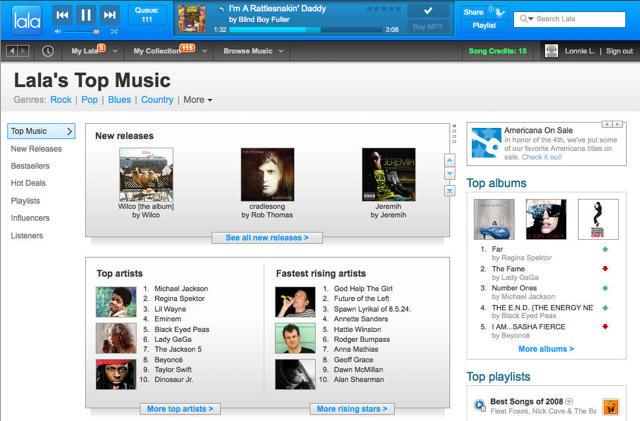
Apple paid $17 million for Lala, the streaming music site, according to reports Tuesday. The final purchase price was even lower – $3 million – due to $14 million already in the Palo Alto, Calif. company’s coffers, said TechCrunch.
“Lala had plenty of cash in the bank, but they were burning $500k/month,” according to sources with indirect knowledge sited by the blog. The purchase price is similar to similar media buys, such as MySpace’s $10 million deal for social-music site iLike or the $1 million paid for music site iMeem.
AT&T have released a free tool to the App Store to allow iPhone users experiencing sub-standard service to help AT&T’s technicians improve the network.
By downloading the free Marks the Spot App to your iPhone, you can easily report any service failures you might experience. Dropped a call? No coverage? Data failure? Poor voice quality? Simply load up the app, allow it to pinpoint your position using GPS, select how often the problem happens to you in that area, then fire off your complaint to AT&T’s crackerjack network engineers, who will presumably slap up a new carrier tower in the blink of an eye. Or, at least, roll their eyes, theatrically yawn and go back to sleep.
Right now, of course, it’s impossible to know if the Mark the Spot app is just a placebo public relations tool to mollify their customers, or if AT&T will actually prioritize improving their network by identifying the holes in their cell tower web and patching them up.
Either way, though, it’s a fantastic idea: so fantastic, I wonder how long it is before tools like the Mark the Spot app ship on all smartphones across all networks. In fact, given the fact that the iPhone can already detect when a phone experiences network service problems like dropped calls, I wonder why the iPhone OS doesn’t automatically cough up a tool just like Mark the Spot when it detects an outage.
In an unusual move, Apple has removed 1,000 applications sold by Chinese developer Molinker from its App Store. The mass purge follows questions whether the developer had ‘gamed’ the popular iPhone online store. Along with the apps – which amounted to one percent of those sold through the App Store, ratings were also deleted.
“This developer’s apps have been removed from the App Store and their ratings no longer appear either,” Apple marketing head Phil Schiller confirmed to iPhoneography, a blog that originally asked whether a scam might have been afoot.
A group of four magazine publishers and media conglomerate News Corp are expected to announce Tuesday a joint venture aimed at developing new standards for digital magazines, according to a report. The move is seen as preventing Apple or other e-reader developers dictating a new age of digital publishing.
The new company — as yet unnamed — will be jointly owned by Hearst, Time Inc., News Corp., Condé Nast Publications and Meredith Corp., according to The Wall Street Journal.
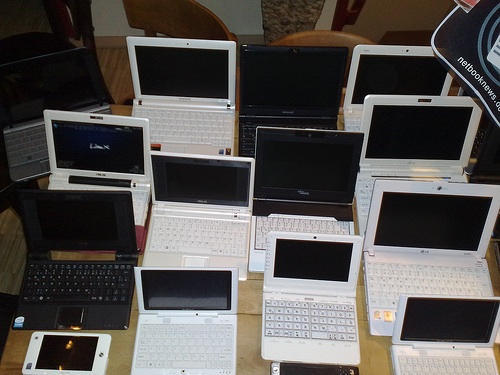
Remember when Apple Chief Operating Officer Tim Cook described netbooks as ‘junky’ at a time PC makers were flooding the market with the low-cost computers? A new reliability survey seems to defend Apple’s decision to avoid entering the netbook arms race. Apple has earned the top spot as most reliable computer maker, dethroning ASUS, creator of the Eee PC netbook.
Apple’s score of 374 reverses the lead ASUS had in late 2008 and earlier 2009, according to computer repair firm RESCUECOM. “Now that many of the netbooks by ASUS have been out for a while, there is obviously a higher need for service,” said the repair company’s CEO David Millman.
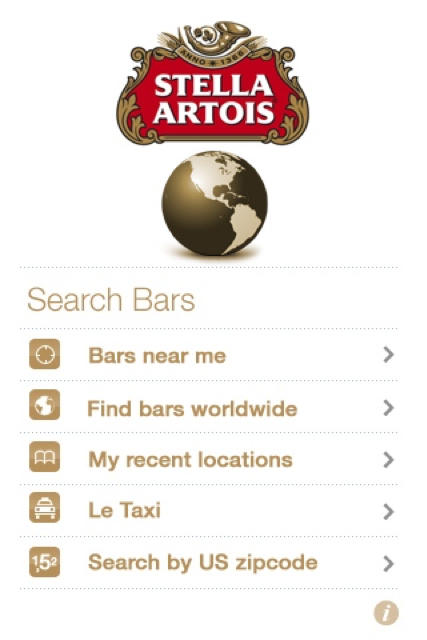
Now, if you’re in the middle of a pub crawl, your reality is already pretty augmented. But if you’re just starting out, or aren’t yet wasted to the point where dropping the iPhone down a street grating is a real possibility, then finding the closest watering hole has never been easier — thanks to Belgian beer-maker Stella Artois’ just-released, free, augmented-reality bar-finder app.
Although officially tight-lipped on details, Apple may use recently-acquired music streaming company Lala to upgrade its iTunes service and potentially other applications, reports suggest Monday.
“Lala gives Apple browser/Web-based technology to access music anywhere,” financial analyst Maynard Um told UBS Investment Research clients. Um believes Apple will combine the Palo Alto, Calif. company with a planned $1 billion server farm to “provide seamless access & mobility of digital content across all of its products, including media-focused content of iTunes and user-generated content of MobileMe.”
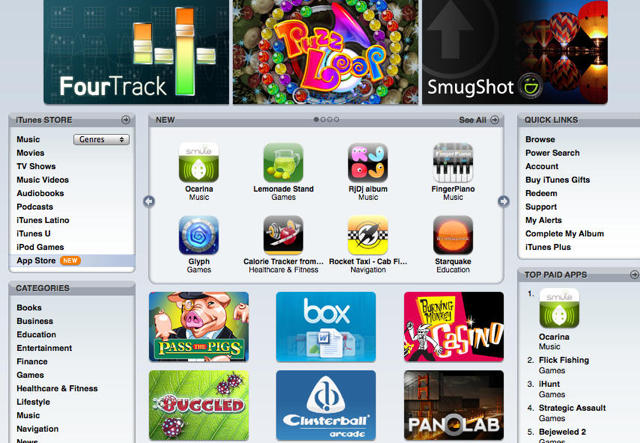
The iPod touch, Apple’s game machine, is becoming Cupertino’s way to introduce younger users to the iPhone. The phone-less iPod represented more than 40 percent of the devices running the iPhone OS software sold through September, according to researchers.
The iPod touch is “quietly building a loyal base among the next generation of iPhone users,” announced mobile analysis software firm Flurry. The study also suggested young iPod touch owners are using the device for games and social-networking. Flurry found 42 percent of the iPod touch sessions include social-media while gaming is 49 percent of the device’s sessions.
AT&T’s latest advertisement to tackle Verizon’s “There’s A Map For That” ads uses Luke Wilson, his twin and a decapitated doppelganger to make its point: AT&T’s 3G network is faster than Verizon’s.
As an ad, it’s certainly funny to watch Luke Wilson stumbling around, noggin-less. Guillotined by Verizon’s slower 3G service, Wilson’s body becomes a random engine of nerve endings chaotically firing, like a chicken with its head chopped off. The ad ends as Wilson’s headless body collapses to the floor, deftly cutting away just before his bowels loosen. The intact Wilsons then wander off for a snuggle.
The argument the ad is making, however, seems poorly thought out. AT&T certainly does have a faster network than Verizon… in fact, Verizon’s never contested that fact. What AT&T doesn’t have is anything even approaching Verizon’s coverage.
If you break this ad down to what it’s saying beyond the quirky charm, AT&T is making the following argument: if you are in an area with AT&T’s fastest 3G coverage, you can download a JPEG of Luke Wilson 20% faster than you can download it anywhere on Verizon’s network. That’s great, but most people would take reliability over a 20% boost in speed. AT&T would do better taking the money they are spending countering arguments Verizon has never made into their infrastructure, countering arguments Verizon has made.
In America, filing for a patent is simple, and a patent is often approved by clerks with no actual knowledge of the technology in question. That makes it all too easy to file for frivolous, overly broad patents… then sue other companies for massive pay outs when they unknowingly infringe.
You don’t need any more information to recognize that the entire patent system is completely broken than to just mull over the fact that Apple is being sued over the iPhone’s camera by a small company made up of exactly two lawyers and six staff members whose entire business is patent infringement. And Apple is likely to pay.
As a sidebar to her mega-tribute to Apple’s mobile dominance, Jenna Wortham of the New York Times asked Phil Schiller about his favorite iPhone apps. And, quelle surprise, they’re all extremely popular, many of them having been featured in TV ads and Apple keynote events.
Shazam — The remarkable music-identification app has been featured in a TV commercial and regularly appears in print
CNN — The country’s No. 2 24-hour news network (and one of the most popular websites on the Internet) has been a perennial top-seller on the App Store, at one time hitting No. 1 for all paid apps
Facebook — Featured in more than one ad, and is the most popular social network in the world
MLB.com At Bat — Featured in TV ads and not one, but two Apple keynotes
NBA Game Time — Basically the above, but for basketball
ESPN ScoreCenter — The same, but for more sports
Eliminate — Demoed on stage at the introduction of the iPhone 3GS
geoDefense — Actually not that hyped. Probably the most obscure title on the list, but it’s still been named one of Apple’s top 4 favorite iPhone games
Best Camera — Created by award-winning iPhone photographer Chase Jarvis, but a legitimate app store success story developed by an indie team and rising thanks to its merits
What do you reckon? Does your taste trend with Phil’s, or is he hopelessly vanilla in his picks?
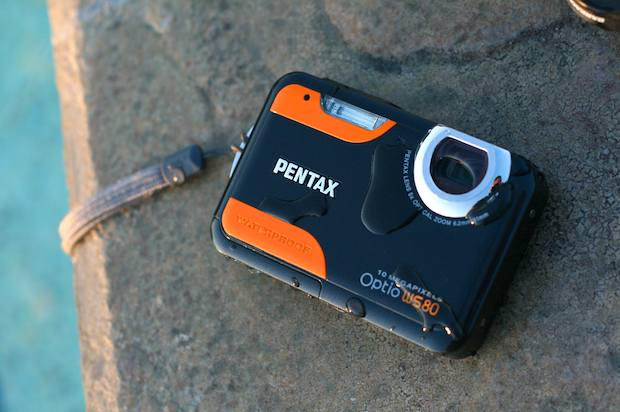
In a sea of bulky, boxy waterproof cameras that do little to encourage stashing them in a pocket and bringing along for the ride, the Pentax Optio WS80 is a refreshing change — it’s tiny, and practically begs to be stuck in a pocket and brought on the next romp. But that scaled-down size is at least in part responsible for scaled-down performance.
Harry McCracken at Technologizer is worried that Apple’s rumored purchase of Lala could be the best thing for iTunes – or the worst.
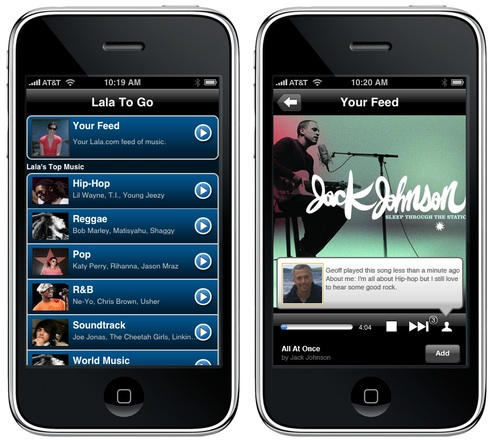
Harry has been testing LaLa’s as-yet-unreleased iPhone app, and it’s just like iTunes in the cloud. The app streams your iTunes music collection to wherever you are, plus you can buy new songs for a dime (well, streams of new songs).
“…all of a sudden, the iPhone’s relatively skimpy memory isn’t nearly as much of an issue, since you can stream all the music you’ve got in iTunes on a PC or Mac to your phone. You can also listen to and buy songs from Lala’s 8-million song store. It’s all surprisingly fast for a streaming service, and it even caches recent music you’ve listened to so you’re not completely out of luck if you don’t have an Internet connection.”
Harry is in love, and hopes that Apple will roll Lala’s functionality into iTunes if Apple buys the company. But he’s also worried that Apple may be buying Lala to kill it — it’s a competitive threat to iTunes.
Over at Silicon Alley Insider, the same notion is implicit in a quote from an industry insider who says LaLa’s licenses are non-transferable:
One industry source with years of experience in the digital music business is very surprised by the apparent deal. “I would be completely shocked,” he says. “None of the licenses are transferrable (not that Apple has a hard time getting licenses). Why would they buy it? Again, I’d be shocked.”
Thing is, as far as I know, Apple has no history of buying companies to shut them down. Anyone know any examples? And as Elliot Van Buskirk at Wired points out, Apple does have a history of buying companies to kickstart new products. Apple’s iTunes was based on SoundJam.
In addition, as we reported in August, Apple is building a one of the world’s largest data centers in North Carolina. Given it’s enormous size, the new data center is likely to focus on cloud computing, perhaps hosting services like Lala’s for Apple’s giant iTunes customer base.
Breast Cancer iPhone App Trucker Hat: http://www.zazzle.com/breast_cancer_iphone_app_hat-148579326076856596
A new study looking at decades of cancer data has concluded that cell phones do not cause brain tumors.
Scientists looked at cancer rates in Europe after cell phones were introduced and found no rise in brain cancers. If there was a link between cell phone radiation and brain tumors, there would have been a rise in cases after the mid-1990s, when cell phones became mainstream, the researchers figured.
Luckily for us, there wasn’t.
Reported in the Journal of the National Cancer Institute (JNCI), the Time Trends in Brain Tumor Incidence Rates study analyzed national cancer registeries in Denmark, Finland, Norway and Sweden between 1974 to 2003 — a mountain of data that covers the entire adult populations of those countries, a total of 16 million people.